We arrived on Easter Island on December 7th. 2009.
It’s a young boys dream come true.
Here they call the island: Rapa Nui and I can’t do anything about it.
The island’s name dates back to Easter Sunday, 1722 when the island was discovered by Jacob Roggeveen, a Dutchman.
Captain Cook (famous all over New Zealand) re-discovered (?) the island a few years later. How can one re-discover something after a few years??
Rapa Nui is a three sided island withy sides of resp. 16, 17 and 24 km’s.
Yesterday we left our nice hostel on the beach in Tahiti and we were brought to the Airport.
It was still very warm and we drank lots of water and lemonade.
The plane left the airport at 12.30 in the middle of the night, we flew about 4.5 hours and we arrived at the Easter Island Airport (Mataveri Airport) around 10.30 in the morning, so we lost some sleep.
But that was not too bad because we are well rested.
The owner of our B & B fetched us from the airport and in no time we were in our room. The airport is very close to the town. The only town on Easter Island, Hanga Roa, is only small (3791 inhabitants our guide tells us) and our B & B is on one of the outskirts, next to a Maori holy place of which I just can’t see the name.
When Thor Heyerdahl worked on this island in 1950 (to prove that there has been contact between Easter Island and the Inca’s in South America a long time ago) there were a few people left who directly descended from the original inhabitants of the island (from the Lang Ears* a few and from the Short Ears* a little bit more).
Nowadays everybody is “mixed” with Chileans (because the island is a part of Chile), French (from “par example” Tahiti and other islands of Polynesia) and other people from all over the world who like to live here (life is rather beautiful over here if you don’t mind living in sober surroundings).
* For history about the Long- and Short Ears see below.
Our landlord here on Easter Island is a Frenchman who only speaks French and Spanish and since our French is fluent he took care of us by asking an air stewardess to come with us on our tour around the island, to translate his French in our English, which was very nice and now we understand all about the island history. Me especially!!
Most of the following is true but since there are differences of mind about
the history of Easter Island, it could be that some other people may think that my stories are not totally true or only half true.
I don’t care much about what somebody else thinks of whatever happened to Easter Island. See what happens.
So, after we arrived in our B & B we got an hour to freshen ourselves up and after that we started with our first tour on the Island.
We visited the following places:
1. Orongo (which is an old crater of the Orongo Volcano).
Beautiful views over the island and lots of historic things like:
. the place where in earlier days the yearly king was chosen; the guy had
to be the first who found an egg of a certain bird on a small island he
had to swim to near the coast of Easter Island and was given 7 (seven)
white wives (they kept the young women for a whole year in one of the
many caves on the island so they were blind - the guy who brought the
first egg could be very ugly without any consequences - , stiff because
they almost couldn’t move in the cave where they were kept and
diseased because they hadn’t seen any sunlight or light at all).
2. Examples of the old stone houses the people on the island slept in,
restored ones and others which were caved in.
The foundations were made of carved stone in the form of a longboat.
The stones had holes drilled in them, to put bamboo stakes in and
these were covered with banana leaves or palm leaves to keep the rain
out.
3. Thrown over Moais (the famous Easter Island monolithic statues of
Practically all men except one or two female Moais ) in a place called
Moto Rua (but it can be another name because they seem
like all the same).
The Moais where thrown over by the “short ears” who rose up against
the “long ears”, the long ears being the guys who enslaved the short
ears who had to do all the chores on the island for the long ears, like:
= cutting the large statues out of stone (many, many years ago or so!!)
without Black & Decker circle saws, pneumatic drills, even normal
iron handsaws or even without any iron (hand)tool but just with
basalt- or obsidian - home made- axes (imagine that!!!!!).
The statues (Moais) are carved out of the rocks in one piece, from 6
to 8 meters long, sometimes 1.5 meter wide and weighing thousands
of kilo’s. The longest is more than 18 meters!!,
= transporting the statues* all over the island (sometimes more than 12
km’s from the quarry) and I can tell ye, Easter Island is hilly like
unreal (it has three old volcanoes and lots of hills), so………..
= erecting the statues and top it with a Pukao (see below),
= finding and transporting water,
= growing vegetables, catching fish, doing all the household chores
including doing the dishes and cleaning the garbage cans,
= etc.
Which means that in effect the short ears had to do everything and the
long ears (doing nothing furthermore) just ordered the short ears
around.
There is a proof of this phenomenon.
Almost all of the Moais show arms with hands with very long nails
like the Chinese upper-class people who had the same long nails, to
show that they didn’t have to work (no short or broken nails).
The Moais represent the Long Ears.
* Scientists differ about the way the Moais were transported over the
island considering there was not much wood about (at times there
were no trees left on the island because the wood was used for
building and heating), there were no (loading) cranes and other
heavy machinery and no horses and no heavy helicopters.
Some scientist believe the Maois were transported using wooden
trunks to roll them over but others, more recently, believe that they
were transported, standing up. They say here: “The Moais were
walking on the island - so: upright -. Who knows?? Who cares??
4. A place called a “Taheta” where you could see a certain star
constellation on this one certain night per year in the water mirror of a
large stone cup (or something like that). Imagine this. Guys without the
knowledge* we have today were able to make these things, 1500 years
ago!!!!
* Apparently they could do a lot more than us at the time.
5. A row of seven Moais, the only ones who look at the sea, and all the
other look inland to watch over the people of the island; it is true and I
don’t make this up because I know my history and I did my homework
before we went on our trip, yes!!).
These seven Moais represent a group of seven sailors send away by the
island king to find new resources and whatever.
6. A heap of stone hairdo’s (Pukao) the Maois wear when standing
upright and when complete, still to be transported all over the island
(the stone hairdo’s being at least one meter high and one meter wide),
These hairdo’s were quarried in a different place on the island
because they are carved from different (red) lava stone.
These Pukao were transported all over the island as well and you can
find these everywhere (like the Moais).
7. Not unimportant, one of the local supermarkets where we bought two
bottles of water and some other stuff.
It was a nice day, specially because we had a very good dinner (together with a Swiss couple (from Switzerland of course, you’ll see them everywhere, even in Switzerland) and were brought back in time to get some sleep.
As a matter of fact we wanted to go to the best restaurant (according to the Lonely Planet) of this island, but this toko was “complet”.
So we went to another restaurant which was OK.
When you read this it will be (at least) Tuesday or Wednesday or even later because my laptop doesn’t get access to the Wifi here.
You’ll find out when you read this.
All is well on Easter Island and everybody is very relaxed over here.
The people here don’t seem to have to much to do.
All the kids have a three month holiday (December, January and February). The boys are surfing on the waves or playing soccer (there is a soccer flied in town) and the girls are trying to look nice like everywhere.
Today is the day after yesterday (yesterday is the day on which I started informing everyone about Easter Island). I think today is the 8th.
If you don’t get this, it doesn’t matter. I didn’t get this either.
What did we do today?
This morning we had breakfast first around 9.00 o’clock.
Around 10.00 we started today’s tour.
The weather was fine (really warm) so a fine day to see parts of Easter Island we haven’t been till now.
We visited:
I
(The highlight of the day) Rano Raraku, the quarry where the old Maori people (the Long Ears and the Short Ears of which the latter did all the work) carved the statues.
You can see here these statues (Moais) in many different stages of “construction” which tells us that at the time hundreds of island people were working at the same time at the carving of the Moais.
It’s the place where you can see the “newest” Moais, almost ready to be transported, all over the Island.
It is awesome and breathtaking (you had to climb to the quarry).
As far as I am concerned it is the most intriguing place of the island because I signifies the most important event on the island ever when the stone carvers suddenly stopped (or had to stop) with their work.*
And although many statues were erected on the coast of the whole island, here and there you can find Moais, more or less far away from the quarry on several places in the interior of the island as well, apparently not yet delivered to the place where they were meant to go.
Some of the remaining Moais were shot at (the bullet holes are still well visible) by Fijians who invaded the island some 100 years ago and since nothing of much value could be found, they used their time on the island by practicing their guns on the Moais.
* Archeologists think now that the Island must have been invaded by Inca’s around 1450 because there are lots of traces (carbon dated the same time) from the Inca’s, for instance dug up seeds in the crater lakes on the island, just the same as you can find in South America.
And they discovered in the same sediment rests of plants and animals which live in South America as we well and which didn’t exist till that time on the island.
It is believed that the Inca’s took most of the islanders back to South America as slaves.
The Inca’s thought the island uninteresting, difficult to live on (little water, difficult to grow food) so they got lots of inhabitants off the island, brought them back to South America as slaves so they had some use (of the people) of the island.
II
A place called Akahanga.
Here you can see seven or eight Moais of which all are lying around like fallen domino stones.
All over the island you can find the “fallen” Moais.
People think nowadays that the short ears pushed them over after they slaughtered the long ears.
In the book Aku Aku of Thor Heyerdahl, an archeologist from Scandinavia, you can read that most of the long ears were slaughtered and burned after being defeated by the short ears.
Thor Heyerdahl and other archeologists (amongst which a certain William Malloy *) found traces of this slaughter in 1950 in a few of the many caves on the island.
* William Malloy helped the islanders to re-erect many Moais, to restore them if possible and that kind of thing.
Malloy died in the island and got a grave in a special place in the town of Hanga Roa. He is still honored for everything he did to restore the Moais in their old splendor.
III
Another place called Ahu Nau Nau.
Here we could see three Moais as the erected statues were meant to be, on a platform (called Ahu and since there are many platforms all over the island lots of places start with the name “Ahu”) with Moais and on top the red hairdo’s (called Pukao).
IV
Many chicken houses, made of stone, called “Hare Moa”.
At the time the wealth of an islander was counted by the amount of chickens he possessed. So they built many of these stone chicken houses to protect the chickens during the night.
V
A place called Ahu Tongariki with not less than 15 Moais in a row and all of them erected, looking inland (so they could watch over the people).
These 15 Moais were overturned at the time by the short ears, but after Japan had one Moai on loan for some exhibition around 1980 and returned the statue with lots of damage (for instance the statue lost one of its ears and other pieces were off as well) they took it upon themselves to restore the 15 Moais in their old fashion, standing on a “Ahu” looking inland and one of the Moais even has his red Pukao on its head.
VI
A place called “Ana te Pahu” (“ana” means cave).
The island used to be volcanic and after eruptions many caves were created by lave streams and these caves were used by the islanders to take shelter against the elements and invaders and during the war between the long ears and the short ears as a safe haven for the long ears (but that didn’t help them much; most were slaughtered).
The caves were also used as places to grow trees (for instance fig trees) to keep them safe from the fierce and salt sea winds.
VII
All kinds of other places with for instance petroglyphes (carvings in stones of turtles, boats, birds and so on), a place near one of the few white sand beaches with palm trees, planted by the French as a gift to the poor people of Easter Island around 1960 or so, places called “Pipi Horeko”, stone land marks used to show where people had their pieces of land, and other “Ahu’s” with standing and fallen Maois.
As I write this, we have electricity (sometimes there isn’t, like today for a few hours) but no access to internet (my laptop doesn’t do what it is supposed to do and that is not really funny).
But we sent an e-mail today to AK from an internet café without café. So the kids know that we are still alive and kicking (or so).
This day we have a day “off”. We did some shopping (mailed a postcard to Mika), walked around the town Hanga Roa, had lunch in the towns best restaurant (French chef) and we will go there tonight again (ha, ha, ha), looked at a small fishing harbor with guys surfing on the waves. We did some reading, walking/climbing on the rocky beach (me, looking for shells but there aren’t any!!) and nothing much more.
Our plans for tomorrow are to rent a car to visit Rano Raraku (the quarry of the Moais) again, because I want to make more pictures of this beautiful place.
After that we’ll probably do some shopping and after that we’ll have to pack again for the flight to Santiago.
When you read this we’ll be in Santiago for sure.
Our landlord has a Christmas tree in the living room and it looks really funny, when you look outside (everything warm and holiday like) and, of course, no snow or cold. Sometimes it rains very hard though.
Today is our last full day on Easter Island.
As I wrote before I wanted to go back to the quarry (Rano Raraku).
Rano Raraku is THE place to go when you want to see Maois, like New Zealand is THE place to see sheep, as the interested reader must have learned.
So we hired a car, threw our stuff in and went hunting for Moais.
And thus we went to Rano Raraku.
You can see the Moais in Rano Raraku in lots of stages of “construction”:
- just the form in the rock, carved only for maybe 20 or 30%,
- still “sitting” in the rock, with the head already carved,
- almost ready, with the back (they did the back in the end of the carving)
still attached to the rock,
- loose from their place in the rocks, but not finished (for instance the
hands with the long nails were carved after the statue was transported
from the rocks away),
- Moais about 20 or 30 meter away from the rocks,
- a “small” Moai carved from a larger one that broke up during the first
so many meters of the transport (which means that when a Moai broke
up during transport they used the two parts to carve two smaller ones),
- other Moais much further away (these were almost finished, were
already on transport but not really far away form the quarry,
- a large one (15 meters or so) in at least five or six pieces of which the
scientists believe that it was transported standing up (or at least was
standing up) and destroyed on purpose because if it had just fallen over,
it would have been apart in only two or three pieces at the max.
If you don’t understand than go look for yourselves.
When you are standing at the base of the quarry you can see all these Moais and the longer you look, the more Moais you find in the rocks in their stages of construction.
It’s amazing!!!
Luckily we were one of the first people this morning to look at these Moais (the official trips start somewhere else) and had all the possibilities to make pictures of many of the Moais, without other people standing around and ruining our photos.
After Rano Raraku we drove cross over the island, looking everywhere for Moais and other stuff, we didn’t see before.
And than it started to rain like there should be a deluge (might be French) and we decided to go to the museum.
The museum was OK but ranks low on our list of “Must See’s” but what can you do when it is raining and you are on Easter Island?
One thing they showed well, were the ways the islanders could have transported the Moais (at least in 5 different ways). And what became clear there, was, that there are no theories about how the islanders put the Pukao (the red lava stone hairdo) on the heads of the Moais.
After visiting this very exciting museum we went home,
Ankie for a nap and me, hammering away behind the laptop.
It still rains but the temperature is fine.
This evening (third time) we went to the same restaurant again (we are only once on Easter Island so we enjoy) and had nice steaks (au poivre).
It appeared that the Spanish king and his wife had dinner here not a long time ago.
The place looks like a dump (apparently the inventory should be as cheap as possible) but the chef is great and so is his food.
Tomorrow we will fly to Santiago de Chile.
And then I’ll tell you more.
Greetings from Easter Island.
vrijdag 11 december 2009

zondag 6 december 2009
Last day on Tahiti
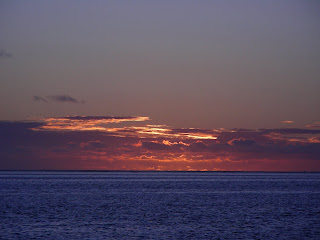 It's Sunday and we have to leave the Island.
Our plane will fly in the middle of the night (To Easter Island) and we have to pack our suitcases and everything else as well.
This is a picture of last evening (just after sunset).
So, Easter Island here we come.
Tahiti

We are here only for three days and today is our last day on Tahiti Island. It is beautiful over here.
Wish I could stay longer.
But...........Easter Island is already calling and we have to pack our suitcases again.
Tahitian fishermen

The sea is blue, the fish are colourfull (It just looks like the big aquarium in the Blijdorp Zoo, but then without all the visiting people)and the people of Tahiti are very friendly.
Look in the boat.
Tahiti surfer

When we were walking along the beach (it is sunday) we saw this guy surfing.
I like to surf too, but I am to old, I am afraid.
Swimming is much easier and that's why we do this all the time.
The water is very nice (26 or 27 degrees C).
On Tahiti they don't have sheep; I didn't see any.
vrijdag 4 december 2009
Tahiti girl with catamaran
 Well, the title says all.
This is the reason we are on the beach all the time and we are enjoying ourselves very much.
Till now we didn't found coconuts but I believe we will have some soon.
Waterfall on the coast of Tahiti

When walking along the beach we found this waterfall (there are high mountains on Tahiti and some are 2000 meters high) and there are lots of waterfalls on the island.
Of course there was this nice tahitian girl who liked to pose for us and we even didn't have to pay.
They walk around almost bare naked and I go to the beach all the time.
Sailing boat on the sea near Tahiti.

WSell, this is a typical Tahitian sailing boat (look at the lateen sail and the baot itseld, a sort of catamaran).
Paul Gauguin

This is a copy of one of the paintings of Paul Gauguin (famous throughout the world and especially in France, Europe and Tahiti and everywhere else).
He lived here for a long time and died overhere in 1903.
There is a Gauguin Museum of course, but I don't know whether we will visit this museum because our landlord told us it is not worth the while.
The Bounty
 Tahiti has a rich history and one of the main "historic events" was the mutiny on the HMS Bounty some 150 years ago.
The mutineers sailed arount Tahiti too and some of them were left on this island and (our tour guide tells us but I don't know whether this is true) their descendents still live on the island.
Island in the front of our beach

This island lies not far away from our beach.
If you look well, you see a girl in the sea.
The beach

When we leave our appartment this is what we see and since there are no other guests (the crisis hits this island as well) it is OUR beach.
Map of Tahiti
 This is the Map of Tahiti.
We are staying near a little village of which I don't know the name yet but it is on the west coast of the island near the first T of Tahiti on this map.
On Tahiti Island
We are now on the Tahiti Island.
When we landed on the airport there was a three men band playing Tahitian music and the hula girls were dancing on the platform.
We all got a nice smelling garland around our neck and after that we had to go through customs and then we were brought to our hotel/appartment.
It is a small complex with (I think) about six or seven "appartments" and ours has see view when you look out of the windows.
We are the only guests so we have everything for ourselves and it is relaxing (I can tell ye!!!)
This morning we visited the supermarket and bought our groceries.
We have had breakfast and lunch already and tonight we go to a small restaurant, about 300 meters away from our appartment.
We swam in the see too and the water is very nice, not to cold or to warm, super!!!
The complex is well maintained (beautifull garden) and we can go canoeing this afternoon (maybe if we like to go).
This ia all for today.
Everything is OK.
When I look outside (the sliding door is open) i see turtles swimming and sunning.
When we landed on the airport there was a three men band playing Tahitian music and the hula girls were dancing on the platform.
We all got a nice smelling garland around our neck and after that we had to go through customs and then we were brought to our hotel/appartment.
It is a small complex with (I think) about six or seven "appartments" and ours has see view when you look out of the windows.
We are the only guests so we have everything for ourselves and it is relaxing (I can tell ye!!!)
This morning we visited the supermarket and bought our groceries.
We have had breakfast and lunch already and tonight we go to a small restaurant, about 300 meters away from our appartment.
We swam in the see too and the water is very nice, not to cold or to warm, super!!!
The complex is well maintained (beautifull garden) and we can go canoeing this afternoon (maybe if we like to go).
This ia all for today.
Everything is OK.
When I look outside (the sliding door is open) i see turtles swimming and sunning.
donderdag 3 december 2009
TAHITI
And what did I tell you guys? Here they are, the hula girls form Tahiti.
We all got garlands (or something like that) around our necks when we left the plane, got kissed over and over and they promised to be on our beach every day!! This will be a very nice part of our holiday in Tahiti and I will tell you all about when we have arrived at our hotel.

The temperature is very good (28/29 or so) and the island is beautiful as we thought it would be.
We will now unpack and see what awaits us on the beach tomorrow.
We all got garlands (or something like that) around our necks when we left the plane, got kissed over and over and they promised to be on our beach every day!! This will be a very nice part of our holiday in Tahiti and I will tell you all about when we have arrived at our hotel.

The temperature is very good (28/29 or so) and the island is beautiful as we thought it would be.
We will now unpack and see what awaits us on the beach tomorrow.
Bye bye New Zealand and aloha Hiti Moana villa's

It's now friday the 4th. and tomorrow it will be friday again (in Tahiti).
In an half hour we'll be brought to the airport in Auckland and we'll fly around 15.00 hours to Tahiti (Papeete is the capital city).
After we have landed in Papeete somebody form our hotel there will fetch from the airport and we will be brought to Hiti Moana Villa's.
An d I'm sure the hula girls await us at the airport (our tour guide promised).
This isa it for today and till the next time.
woensdag 2 december 2009
The last picture of New Zealand

This is a gull on the hot water beach in the evening. I think it is a nice gull.
Funny
The day before yesterday we were camping and next to us was a small campervan with on its tail:
"Proudly baking Possum Pancakes since 1992".
I thought it was funny.
"Proudly baking Possum Pancakes since 1992".
I thought it was funny.
Entrance of the Waipu Museum in .............. Waipu
 The entrance of the Waipu museum with a Scottish "welcome" which I can't read but then, I am not a scotsman and the Scotts are.
The Waipu museum in Waipu
 Picture of a bagpiper in the Waipu museum in Waipu.
It's not the best picture I made in New Zealand because of the glass in fornt of the bagpiper.
But.......it looks Scottish.
Helenville North Island
On this rainy day it is Wednesday december 2nd. 2009 and we reached Helenville.
So Helen, you must have achieved a lot since they thought here to name their city (or village or ville) after you. Congratulations!!!
We don’t know what is exciting about Helenville, because we didn’t try to find out (it rains practically all day) but it has lots of old buildings (from 1912 I saw one: the post office) and the town main street looks like Dodge City but than mostly built of stone.
And of course there was no Wyatt Earp or Daltons in sight.
This morning we left Wangharei (which is a rather large city; you could get lost over there) and thus set for Helenville.
Why?
Apart from the old buildings (in every town and village they are very proud of their old buildings, as you can imagine and that is why they all have a city museum with old stuff of like 50 years old and so) there are hot pools and Ankie is going to go there, this afternoon. It doesn’t matter when it rains and you are lying in some hot spring pool.
You get wet anyway, isn’t?
Somewhere, halfway to Helenville we visited the town of Waipu.
Waipu is a city with a Scottish heritage or something like that.
As you know the living conditions 200 years back in Scotland were bad.
Highland landowners in Scotland discovered the opportunity to make wealth form sheep farming and they forced their traditional tenant farmers (not seldom kinsmen) off the land and replaced them with sheep and I suppose you know ALL about sheep now.
Thousands of Scotts were forced to emigrate and in 1817 the first small group left the West Highland port of Ullapoole (very well known in Ullapoole and surroundings; they have one hotel/restaurant* and six houses now. I have seen that myself) destined for (YES!!) Nova Scotia.
They were under the leadership of a forceful Calvinist preacher Norman Mc Leod.
Looking at his photograph (there are a few) he certainly didn’t go happy and joyful through life. No frolics with the Reverend Mc Leod!!
* The food was awful and the service the same.
To cut the story short, they lived a while in Nova Scotia in St. Ann’s**, Cape Breton, but famine and sickness produced disaster and than was decided to look for a better life in Australia.
With six ships they sailed for Australia.
The ships names (you have to know your history and somebody elses!!):
- Margaret,
- Highland Lassie (doesn’t have anything to do with rice),
- Gertrude,
- Spray,
- Ellen Lewis (called after some girl of the Isle of Lewis or so),
- Breadalbane.
After much hardship (storms, typhoid and one or two ships almost wrecked on some rocky coast) the Scotts arrived at Adelaide but unfortunately there was a drought and no land available but Mc Leod successfully negotiated with the New Zealand Governor for land in New Zealand.
Since they sold their ships in Australia they had to purchase another one named “Gazelle” and around 1850 about 940 Scotts found their “Promised Land” in the North Island, near and in the town of Waipu and thousands of descendants (they didn’t sit still during the day and the night) live their today. Waipu doesn’t look Scottish but the names on their mailboxes are certainly Scottish like:
- Mc Beth (very well known in England as well),
- Mc Leod,
- Mc Duff,
- Mc Lennan,
- Cameron,
- Duncan,
- MacLean,
- MacKenzie,
- Roberts,
- Munro,
- McKay (do you remember Bobby?),
- McInnes,
- Mc Donald (famous all over the world),
and lots and lots of other Macs.
** Here something about a guy, famous in Nova Scotia and apparently in Waipu as well: Giant Angus McAskill.
He lived in St. Ann’s around the time that the Reverend McLeod decided to find a land where they could prosper.
Angus McAskill was well over 2.50 meters (or so) and his hands were 20 cm’s wide and 30 cm’s long (to get the idea) and he was the strongest man around.
Many tales are told about this giant.
One is as follows:
Once, coming home late with a load of firewood the oxen were so slow that Angus decided to unyoke them and pulled home the wood himself in no time.
Another story tells us that the fishermen of St. Ann’s envied his strength.
While they laboriously bailed out their boats, Angus set his weight under his half ton boat, tipped it up on its beam ends and bilged out the water.
I tried to make a photograph of the portrait of Angus in the museum
but I failed because almost every portrait and picture sits behind glass and then it is very difficult to make a good picture.
So, shit happens and no picture of Angus.
All about Angus and the story of the Scotts who came from the highlands and arrived at Waipu in the end, you can see in the Waipu Museum in an exhibition called “from croft to cottage” about one of the most extraordinary global migrations in world history (our guide tells us).
Museum Opening Hours
9.30 am – 4.30 pm
7 days a week,
But…………….……………..winter hours may be reduced so if you go there during the winter, call them first 09 432 0746.
E-mail: info@waipumuseum.com.
This was the main event of this day.
Tomorrow will be our last full day in New Zealand.
The day after - on the 4th of December - we will fly to Tahiti!!!
When we are there I will explain why Tahiti is well known throughout the whole world, but now already I can lift one tip of the veil:
- dancing Hula Girls will await us with bare (.)(.) !!!
When you read this, it will be the 3rd. of December or maybe even the 4th (there is no wireless on the camping in Helenville and if you look at the faces of the people around here, they won’t have wireless for a very long time).
As I wrote, we will leave on the 4th. of December and we will arrive in Tahiti on the ………..3rd. (Read “around the world in 80 days” with Philias Fogg and others, amongst which an real Indian Princess as well).
It was a nice day again and till the next time.
We are a little further in time and today is (the next time) and Thursday 3rd. December and we arrived at our hotel in Auckland.
This morning we cleaned (moreless) our campervan and packed our suitcases and backpacks and other bags and the other ones.
We drove from Helenville to Auckland and nothing eventful (to write about) happened and we brought our campervan back (Pacific Horizons the rental company is called) and everything was OK and we were brought to our hotel (The Quadrant) in the city centre and we have free wireless.
It rained practically all day and we have to decide whether to go visiting the city centre in the rain or stay in our room looking TV, read books, etc.
So Helen, you must have achieved a lot since they thought here to name their city (or village or ville) after you. Congratulations!!!
We don’t know what is exciting about Helenville, because we didn’t try to find out (it rains practically all day) but it has lots of old buildings (from 1912 I saw one: the post office) and the town main street looks like Dodge City but than mostly built of stone.
And of course there was no Wyatt Earp or Daltons in sight.
This morning we left Wangharei (which is a rather large city; you could get lost over there) and thus set for Helenville.
Why?
Apart from the old buildings (in every town and village they are very proud of their old buildings, as you can imagine and that is why they all have a city museum with old stuff of like 50 years old and so) there are hot pools and Ankie is going to go there, this afternoon. It doesn’t matter when it rains and you are lying in some hot spring pool.
You get wet anyway, isn’t?
Somewhere, halfway to Helenville we visited the town of Waipu.
Waipu is a city with a Scottish heritage or something like that.
As you know the living conditions 200 years back in Scotland were bad.
Highland landowners in Scotland discovered the opportunity to make wealth form sheep farming and they forced their traditional tenant farmers (not seldom kinsmen) off the land and replaced them with sheep and I suppose you know ALL about sheep now.
Thousands of Scotts were forced to emigrate and in 1817 the first small group left the West Highland port of Ullapoole (very well known in Ullapoole and surroundings; they have one hotel/restaurant* and six houses now. I have seen that myself) destined for (YES!!) Nova Scotia.
They were under the leadership of a forceful Calvinist preacher Norman Mc Leod.
Looking at his photograph (there are a few) he certainly didn’t go happy and joyful through life. No frolics with the Reverend Mc Leod!!
* The food was awful and the service the same.
To cut the story short, they lived a while in Nova Scotia in St. Ann’s**, Cape Breton, but famine and sickness produced disaster and than was decided to look for a better life in Australia.
With six ships they sailed for Australia.
The ships names (you have to know your history and somebody elses!!):
- Margaret,
- Highland Lassie (doesn’t have anything to do with rice),
- Gertrude,
- Spray,
- Ellen Lewis (called after some girl of the Isle of Lewis or so),
- Breadalbane.
After much hardship (storms, typhoid and one or two ships almost wrecked on some rocky coast) the Scotts arrived at Adelaide but unfortunately there was a drought and no land available but Mc Leod successfully negotiated with the New Zealand Governor for land in New Zealand.
Since they sold their ships in Australia they had to purchase another one named “Gazelle” and around 1850 about 940 Scotts found their “Promised Land” in the North Island, near and in the town of Waipu and thousands of descendants (they didn’t sit still during the day and the night) live their today. Waipu doesn’t look Scottish but the names on their mailboxes are certainly Scottish like:
- Mc Beth (very well known in England as well),
- Mc Leod,
- Mc Duff,
- Mc Lennan,
- Cameron,
- Duncan,
- MacLean,
- MacKenzie,
- Roberts,
- Munro,
- McKay (do you remember Bobby?),
- McInnes,
- Mc Donald (famous all over the world),
and lots and lots of other Macs.
** Here something about a guy, famous in Nova Scotia and apparently in Waipu as well: Giant Angus McAskill.
He lived in St. Ann’s around the time that the Reverend McLeod decided to find a land where they could prosper.
Angus McAskill was well over 2.50 meters (or so) and his hands were 20 cm’s wide and 30 cm’s long (to get the idea) and he was the strongest man around.
Many tales are told about this giant.
One is as follows:
Once, coming home late with a load of firewood the oxen were so slow that Angus decided to unyoke them and pulled home the wood himself in no time.
Another story tells us that the fishermen of St. Ann’s envied his strength.
While they laboriously bailed out their boats, Angus set his weight under his half ton boat, tipped it up on its beam ends and bilged out the water.
I tried to make a photograph of the portrait of Angus in the museum
but I failed because almost every portrait and picture sits behind glass and then it is very difficult to make a good picture.
So, shit happens and no picture of Angus.
All about Angus and the story of the Scotts who came from the highlands and arrived at Waipu in the end, you can see in the Waipu Museum in an exhibition called “from croft to cottage” about one of the most extraordinary global migrations in world history (our guide tells us).
Museum Opening Hours
9.30 am – 4.30 pm
7 days a week,
But…………….……………..winter hours may be reduced so if you go there during the winter, call them first 09 432 0746.
E-mail: info@waipumuseum.com.
This was the main event of this day.
Tomorrow will be our last full day in New Zealand.
The day after - on the 4th of December - we will fly to Tahiti!!!
When we are there I will explain why Tahiti is well known throughout the whole world, but now already I can lift one tip of the veil:
- dancing Hula Girls will await us with bare (.)(.) !!!
When you read this, it will be the 3rd. of December or maybe even the 4th (there is no wireless on the camping in Helenville and if you look at the faces of the people around here, they won’t have wireless for a very long time).
As I wrote, we will leave on the 4th. of December and we will arrive in Tahiti on the ………..3rd. (Read “around the world in 80 days” with Philias Fogg and others, amongst which an real Indian Princess as well).
It was a nice day again and till the next time.
We are a little further in time and today is (the next time) and Thursday 3rd. December and we arrived at our hotel in Auckland.
This morning we cleaned (moreless) our campervan and packed our suitcases and backpacks and other bags and the other ones.
We drove from Helenville to Auckland and nothing eventful (to write about) happened and we brought our campervan back (Pacific Horizons the rental company is called) and everything was OK and we were brought to our hotel (The Quadrant) in the city centre and we have free wireless.
It rained practically all day and we have to decide whether to go visiting the city centre in the rain or stay in our room looking TV, read books, etc.
maandag 30 november 2009
The Watiki Glow-worm Caves

This is a picture of the rocks in which the glow-worm caves are situated.
You can see the rocks in the middle/top of the picture.
The animals in the middle are cows and we didn't see any sheep today.
Lots of sheep farmers have cows now because they can earn more with cows.
Saint Michael's Anglican Church

This is the church which was built on the spot where the English were slain by the maori's in 1845.
The famous toilet of Hundertwasser in Kawakawa
 This is the front of the colourful toilet of the famous artist Hundertwasser in Kawakawa.
Look at the roof (Hundertwasser was a ecologist as well) and the people of the city of Kawakawa remember him well, beacause he planted thousands of trees but...........the people don't like the trees because they are pinetrees and they have lots of those already.
Hundertwasser and the Kawiti Glow-worm Caves
Today is December 1st 2009 and we are still on the North Island of New Zealand.
Like the last days the day began with a few drops of rain. After that it became less and less clierwdy and the rest of the day was rather sunny and warm.
To have something to do we first went to a city called Kawakawa.
Not too far from Paihia.
Kawakawa is famous throughout the North Island because of the fact that a rather famous Austrian artist (his name was Hundertwasser) lived in Kawakawa for a long time and got the order from the town council to design the city toilet.
Large signs on the side of the road announce the toilet of Hundertwasser.
So we visited that toilet and Ankie even went inside and she told me that the toilet was clean.
Two years ago Ankie and I visited an exhibition of Hundertwasser in our famous and well known city (or village) Valkenburg in Limburg.
So we were of course very excited that we could visit the town where Hundertwasser built a very luxurious outhouse/bathroom/toilet/loo.
On the other side of the street we visited the Hundertwasser Museum which showed lots of copies of paintings of the painter and lots of photographs of the guy, together with all sorts of other people.
In this museum they showed also all the stuff the older people of the town of Kawakawa donated to the museum and so it just looked like all the other town and village museums which show:
- old photographs,
- old chairs,
- old kitchen utensils (like form 50 years back, they think it is really old),
- old books (millions of them),
- old telephones,
- old pots and pans and china and earthenware household things,
- old toys,
- old other things.
In the museum I found the copy of the report of an eyewitness of the battle of Ohaeawai in 1845, 1st of July. The eyewitness was a medical doctor who travelled around and was just there when the battle raged.
Funny to read what happened exactly during the days around the battle.
The second experience of this day was our visit to the Kawiti Glow-worm Caves of Kawiti.
The caves were discovered by a Maori tribe and one of the attendants we were told is a member of the mentioned tribe.
The caves are not very large but “impressive”. Beautiful massive pillars of pure white stalactites, stalagmites galore.
In the caves you can see millions of glow-worms (Arachnocampa Luminosa) and with the Maori name of Pura Toke (So that you know this as well).
This transparent larva of the Fungus Gnat, which has a life cycle of about eleven months, from the egg to the adult fly, aluminates the caves (a little).
The glow-worm grows from 2 mm to 40 mm long. It is as thin as a needle with a blue/green taillight.
It lives of mosquitoes, flies, moths which are attracted by the light and are caught in small chainlike webs the worms grow.
Our tour guide told us these glow-worms only live in caves in New Zealand and Australia.
The visit to these caves was really nice.
We are now camping in the city of Whangarei and we have internet so, we’ll do some updates now.
All is well in New Zealand and till the next time.
Like the last days the day began with a few drops of rain. After that it became less and less clierwdy and the rest of the day was rather sunny and warm.
To have something to do we first went to a city called Kawakawa.
Not too far from Paihia.
Kawakawa is famous throughout the North Island because of the fact that a rather famous Austrian artist (his name was Hundertwasser) lived in Kawakawa for a long time and got the order from the town council to design the city toilet.
Large signs on the side of the road announce the toilet of Hundertwasser.
So we visited that toilet and Ankie even went inside and she told me that the toilet was clean.
Two years ago Ankie and I visited an exhibition of Hundertwasser in our famous and well known city (or village) Valkenburg in Limburg.
So we were of course very excited that we could visit the town where Hundertwasser built a very luxurious outhouse/bathroom/toilet/loo.
On the other side of the street we visited the Hundertwasser Museum which showed lots of copies of paintings of the painter and lots of photographs of the guy, together with all sorts of other people.
In this museum they showed also all the stuff the older people of the town of Kawakawa donated to the museum and so it just looked like all the other town and village museums which show:
- old photographs,
- old chairs,
- old kitchen utensils (like form 50 years back, they think it is really old),
- old books (millions of them),
- old telephones,
- old pots and pans and china and earthenware household things,
- old toys,
- old other things.
In the museum I found the copy of the report of an eyewitness of the battle of Ohaeawai in 1845, 1st of July. The eyewitness was a medical doctor who travelled around and was just there when the battle raged.
Funny to read what happened exactly during the days around the battle.
The second experience of this day was our visit to the Kawiti Glow-worm Caves of Kawiti.
The caves were discovered by a Maori tribe and one of the attendants we were told is a member of the mentioned tribe.
The caves are not very large but “impressive”. Beautiful massive pillars of pure white stalactites, stalagmites galore.
In the caves you can see millions of glow-worms (Arachnocampa Luminosa) and with the Maori name of Pura Toke (So that you know this as well).
This transparent larva of the Fungus Gnat, which has a life cycle of about eleven months, from the egg to the adult fly, aluminates the caves (a little).
The glow-worm grows from 2 mm to 40 mm long. It is as thin as a needle with a blue/green taillight.
It lives of mosquitoes, flies, moths which are attracted by the light and are caught in small chainlike webs the worms grow.
Our tour guide told us these glow-worms only live in caves in New Zealand and Australia.
The visit to these caves was really nice.
We are now camping in the city of Whangarei and we have internet so, we’ll do some updates now.
All is well in New Zealand and till the next time.
The Ngawa Hot Springs
Aone is more grey.
Another tub of the Ngawa Hot Springs and the colour of this tub is almost black where the other is more grey-like. The water in both tubs is warm and if you wanted to, you can sit in them. We didn't dare because everything looked very dirty and since we are healthy (we think) we wanted it to stay that way.
Ngawa hot springs tub
One of the about ten "tubs" of the Ngawa Hot Springs near the village of (you guessed already) Ngawa.
It looks very exciting (and superb) when you click on the arrow of the video. You can see the hot water bubbling. Maybe you have to click twice.
Opononi, Paihia and Ngawa
Today is the last day of November 2009 (Monday 30th.)
Today we drove from Opononi to a place called Paihia. The weather this morning was not very promising (there were lots of clierwds) but, as the last days, the farther we got the better got the weather.
Sitting now in the van, the weather is very nice, the sun shines and the temperature is good, it’s nice and warm.
The journey was uneventful apart from two very interesting visits we made.
After breakfast we left Opononi and drove to Ngawa Hot Springs.
Our tour guide tells us these springs are a thing that can’t be missed, so we went totally for these hot springs.
And, of course there were other people as well (there was a bus full of youngsters/students) to visit this magnificent landmark on the North Island of New Zealand.
We went in and we saw about ten square pools of 3 x 3 meters in which you can sit and enjoy the hot or warm water.
We didn’t go in because the place looked like a dump with foul water pools but, somewhere in a corner a woman was enjoying the warm water.
As a souvenir of this awesome place I made a few small video’s.
We’ll always remember Ngawa Hot Springs!!
After another hour or so we bought the necessary groceries for today and after that we came along another landmark, Te Whare Karakia O Mikaera,
Saint Michael’s Anglican Church of 1871, built on the site of Pene Taui’s Pa (Pa means stronghold), at which was fought the Battle of Ohaeawai, July 1st. 1845.
The battle was fought between the English (who lost) and the resisting Maori’s.
Since there is not much else to tell I’ll inform you about this battle.
During Heke’s war (the English trying to put another gem* in the British crown, the gem being the North Island of nowadays New Zealand) the British troops under colonel H. Despard suffered very heavy casualties in their assault on Pene Taui’s Pa at Ohaeawai.
The assault was a follow up action after two earlier engagements between the English and Hone Heke and Kawiti (Maori chiefs and their warriors) in which the English couldn’t defeat the Maori’s.
The Maori’s had withdrawn to the place where the church later was built being a heavy stronghold with three rows of palisade’s, a deep trench and other earthworks (the architect of the stronghold being the Maori Kawiti). Amongst the stronghold were heavy timbered hidden rifle pits and in all the stronghold would prove to be impregnable to artillery and musket fire.
The force of the British consisted of 565 men amongst which Maori allies, blue jacks of the HMS Hazard and men of two English regiments together with Auckland volunteers.
They had two 6 pounder brass guns and two 12 pounder carronades from a man of war called HMS Hazard. The force was disembarked from the ship on June 23rd. and the colonel marched up to the Maori stronghold and camped about 500 meters down from it.
On June 24th. the first gunshot was fired and although the four guns kept up a barrage the whole day, the shots had no real effect on the stronghold and the colonel ordered a heavier gun (a 32 pounder) from the ship.
This gun arrived on June 30th. in the morning and right away the 32 pounder opened fire together with the 4 lighter pieces of artillery.
During the bombardment a Maori sortie slipped out of the Pa and circling through the forest surprised the Maori allies and the British piquet protecting a 6 pounder gun on a nearby hill.
The Maori’s shot one soldier, seized the 6 pounder and hauled down the flag of the English there on the hill.
Colonels Despards embarrassment turned into fury when he saw the captured British ensign run up on the Pa’s flagstaff and he determined to storm the Pa the same day.
Colonel Despard imagined that four shot - apparently the soldiers brought only four shot from the ship - of the 32 pounder would have loosened the timber palisades sufficiently to enable his troops to storm the stronghold with success and bring down the Maori force.
Remonstrations of his fellow officers against such a useless attack failed to move the obstinate colonel.
He ordered a storming party to parade directly after the bombardment in the afternoon of the 1st. of July and the troops given a midday meal which for many of the troops was their last.
The troops formed up in the valley beyond the Pa about 100 meters from the stronghold. Now came the awful interval of waiting between bombardment and storming the Pa, the parties taking their appointed places while the rear of them still were throwing shot and shell into the Pa.
Than out blared the bugle “advance”.
There as a quick fire of commandments of the column officers and the troops dashed over the ferny slopes towards the Pa.
The troops were within 50 yards of the palisades and the defenders opened fire. It was a one sided fight.
Gun flashes spurted from the base of the stronghold and from loopholes higher up, with gun smoke hiding the palisades and the attackers stopped deadly in their tracks.
Not a single Maori could be seen since they were safely hidden in their trenches between their strong palisades. And although English troops managed to reach the palisades they were not able to break through.
The Maori fire completely commanded the angle which was the centre of the attack and the Maori gun (the seized 6 pounder) killed and maimed many of the attackers.
Through the din of yelling and musketry the notes of the bugle were heard: “retire” and many British soldiers were gunned down in the withdrawal by Maori fire.
The whole action took only five minutes and within that time more than 40 English soldiers lost their lives and more than 100 were wounded, some mortally and others maimed for life. Almost one third of the English force was out of action in those few minutes.
Many a deed of gallantry and devotion illumined the tragedy of that retreat, several men returned through hot fire to carry off wounded comrades.
The total of Maori losses are not known but couldn’t have exceeded ten killed.
After this defeat the English remained camped near the Pa, keeping up a intermittent bombardment during 10 days with the 32 pounder and the other lighter guns, for which new shot was hauled from the ship.
It was Maori custom to leave a Pa when blood was spilled and after the ten day bombardment, when the English dared another attack, the Maori force had withdrawn during one of the nights after the battle.
In January 1846 there was a last decisive battle where the remaining Maori’s lost their independence to the English.
If you like this story I can make others up. There still is Gallipoli, Balaclava, Modderspruyt, Dunkerque, the Boxers of Peking, Trafalgar, etc.
After this bloodbath of 150 years ago (somewhat totally different from bathing in hot springs) we are now at Paihia.
Tomorrow we will go south again, direction Auckland.
Today we drove from Opononi to a place called Paihia. The weather this morning was not very promising (there were lots of clierwds) but, as the last days, the farther we got the better got the weather.
Sitting now in the van, the weather is very nice, the sun shines and the temperature is good, it’s nice and warm.
The journey was uneventful apart from two very interesting visits we made.
After breakfast we left Opononi and drove to Ngawa Hot Springs.
Our tour guide tells us these springs are a thing that can’t be missed, so we went totally for these hot springs.
And, of course there were other people as well (there was a bus full of youngsters/students) to visit this magnificent landmark on the North Island of New Zealand.
We went in and we saw about ten square pools of 3 x 3 meters in which you can sit and enjoy the hot or warm water.
We didn’t go in because the place looked like a dump with foul water pools but, somewhere in a corner a woman was enjoying the warm water.
As a souvenir of this awesome place I made a few small video’s.
We’ll always remember Ngawa Hot Springs!!
After another hour or so we bought the necessary groceries for today and after that we came along another landmark, Te Whare Karakia O Mikaera,
Saint Michael’s Anglican Church of 1871, built on the site of Pene Taui’s Pa (Pa means stronghold), at which was fought the Battle of Ohaeawai, July 1st. 1845.
The battle was fought between the English (who lost) and the resisting Maori’s.
Since there is not much else to tell I’ll inform you about this battle.
During Heke’s war (the English trying to put another gem* in the British crown, the gem being the North Island of nowadays New Zealand) the British troops under colonel H. Despard suffered very heavy casualties in their assault on Pene Taui’s Pa at Ohaeawai.
The assault was a follow up action after two earlier engagements between the English and Hone Heke and Kawiti (Maori chiefs and their warriors) in which the English couldn’t defeat the Maori’s.
The Maori’s had withdrawn to the place where the church later was built being a heavy stronghold with three rows of palisade’s, a deep trench and other earthworks (the architect of the stronghold being the Maori Kawiti). Amongst the stronghold were heavy timbered hidden rifle pits and in all the stronghold would prove to be impregnable to artillery and musket fire.
The force of the British consisted of 565 men amongst which Maori allies, blue jacks of the HMS Hazard and men of two English regiments together with Auckland volunteers.
They had two 6 pounder brass guns and two 12 pounder carronades from a man of war called HMS Hazard. The force was disembarked from the ship on June 23rd. and the colonel marched up to the Maori stronghold and camped about 500 meters down from it.
On June 24th. the first gunshot was fired and although the four guns kept up a barrage the whole day, the shots had no real effect on the stronghold and the colonel ordered a heavier gun (a 32 pounder) from the ship.
This gun arrived on June 30th. in the morning and right away the 32 pounder opened fire together with the 4 lighter pieces of artillery.
During the bombardment a Maori sortie slipped out of the Pa and circling through the forest surprised the Maori allies and the British piquet protecting a 6 pounder gun on a nearby hill.
The Maori’s shot one soldier, seized the 6 pounder and hauled down the flag of the English there on the hill.
Colonels Despards embarrassment turned into fury when he saw the captured British ensign run up on the Pa’s flagstaff and he determined to storm the Pa the same day.
Colonel Despard imagined that four shot - apparently the soldiers brought only four shot from the ship - of the 32 pounder would have loosened the timber palisades sufficiently to enable his troops to storm the stronghold with success and bring down the Maori force.
Remonstrations of his fellow officers against such a useless attack failed to move the obstinate colonel.
He ordered a storming party to parade directly after the bombardment in the afternoon of the 1st. of July and the troops given a midday meal which for many of the troops was their last.
The troops formed up in the valley beyond the Pa about 100 meters from the stronghold. Now came the awful interval of waiting between bombardment and storming the Pa, the parties taking their appointed places while the rear of them still were throwing shot and shell into the Pa.
Than out blared the bugle “advance”.
There as a quick fire of commandments of the column officers and the troops dashed over the ferny slopes towards the Pa.
The troops were within 50 yards of the palisades and the defenders opened fire. It was a one sided fight.
Gun flashes spurted from the base of the stronghold and from loopholes higher up, with gun smoke hiding the palisades and the attackers stopped deadly in their tracks.
Not a single Maori could be seen since they were safely hidden in their trenches between their strong palisades. And although English troops managed to reach the palisades they were not able to break through.
The Maori fire completely commanded the angle which was the centre of the attack and the Maori gun (the seized 6 pounder) killed and maimed many of the attackers.
Through the din of yelling and musketry the notes of the bugle were heard: “retire” and many British soldiers were gunned down in the withdrawal by Maori fire.
The whole action took only five minutes and within that time more than 40 English soldiers lost their lives and more than 100 were wounded, some mortally and others maimed for life. Almost one third of the English force was out of action in those few minutes.
Many a deed of gallantry and devotion illumined the tragedy of that retreat, several men returned through hot fire to carry off wounded comrades.
The total of Maori losses are not known but couldn’t have exceeded ten killed.
After this defeat the English remained camped near the Pa, keeping up a intermittent bombardment during 10 days with the 32 pounder and the other lighter guns, for which new shot was hauled from the ship.
It was Maori custom to leave a Pa when blood was spilled and after the ten day bombardment, when the English dared another attack, the Maori force had withdrawn during one of the nights after the battle.
In January 1846 there was a last decisive battle where the remaining Maori’s lost their independence to the English.
If you like this story I can make others up. There still is Gallipoli, Balaclava, Modderspruyt, Dunkerque, the Boxers of Peking, Trafalgar, etc.
After this bloodbath of 150 years ago (somewhat totally different from bathing in hot springs) we are now at Paihia.
Tomorrow we will go south again, direction Auckland.
The largest Kauri tree ever

You just saw Ankie standing for the largest (left) Kauri tree here in New Zealnd.
This is an old photgraph of an old man standing in front of a large Kauri tree, about a hundred years ago.
That was a big one but, alas, not here anymore.
The biggest Kauri tree in New Zealand

Here you can see Ankie near the biggest Kauri tree in New Zealand called "Tane Mahuta" which means in Maori "Old Father".
The tree is more than 50 meters high, but you can't see that because I couldn't back up more because of other large trees around the largest one.
Majestic Forest Giants (Majestueuse Woudreuzen)
 This day we visited Waipua forest because of the largest Kauri trees to be found on the North Island.
Look at the large trunk of the tree!!

Majestic Forest Giants (Majestueuse Woudreuzen)
It’s November 29th. 2009 and we have rather nice weather.
Being on a holiday requires good weather and although we started this morning with rain (in a place called Red Beach on the West Coast of the North Island) the rain stopped somewhere during the morning and since than it is nice and warm.
So we left Red Beach (didn’t see any beach because it started raining just after we left the boat from Tiri Tiri Mangati and the rain stopped as I wrote, somewhere during the trip in the morning) and went up north.
This day was all about the Kauri.
The Kauri is one of the most well known native trees of New Zealand and probably the oldest living here.
If the New Zealanders wouldn’t have had the Kiwi, they would have chosen the name Kauri’s for their rugby team (or maybe another name, I don’t know of course).
In the morning we stopped at a place called Matakohe.
Tomorrow I won’t remember the name anymore; it’s every day the same.
In Matakohe there is the Kauri Museum.
Our guide tells us that this museum is one of the “Must See” exhibitions of New Zealand and so we went visiting it.
The museum provides “a stimulating insight into the Kauri theme”.
As I wrote before every village and town has at least one museum so there are lots of museums in New Zealand and every one is awesome, stimulating, magnificent, breathtaking, beautiful, very cool, enthralling, superb and so but about these later on.
This one is “stimulating”.
What do you see:
All kinds of old photographs of men cutting down Kauri trees,
transporting parts of Kauri trees, etc.
You must know that Kauri wood has been used by the settlers and boat builders** and house builders since the islands were discovered by Captain Cook, and remained to do so till almost no Kauri tree was left standing in the woods.
There is, as far as we know, only one forest (Waipoua Forest) in which a few large Kauri trees still stand.
** The boat building business was the most killing for the Kauri trees
because its wood could be very well used for building wooden ships.
So a large part of the English fleet at that time was built from English
oak (there is almost no oak tree left in England more than a 100 years
old) and New Zealand Kauri wood. And, as we all know, the English
fleet was very big around 1800. As a matter of fact the English fleet
was the largest and the mightiest at that time.
In this Kauri museum you can see furthermore:
- all kinds of things made of Kauri wood like cupboards, utensils, statues,
pots, children’s toys, war clubs (Maori), etc.
- all kind of things made of Kauri gum (Kauri gum - or amber - is the
fluid which flows out of the tree when branches break off and hardens).
The Kauri tree is millions of years old (our guide tells us and so they
found amber/Kauri gum of million years ago and since the gum was
used for lots of purposes, there was a lot of “gum digging” around 1800,
again photographed around that time and with many, many dug up large
and small pieces of gum,
- china and earthenware from around the tree felling and gum digging
period (what else have they got?),
- books of those times, murals, tables, wine barrels (of Kauri wood of
course), stairs of Kauri wood, photographs of Kauri built racing yachts,
- the inevitable blacksmith’s workshop with tools (of course) with
lifelike models and realistic scenes,
- a quality six room (?) of a 1900 home, fully furnished with original
decor, dressed models giving “a fascinating insight”!!!,
- an original school giving a glimpse of early education in New Zealand,
complete with desks, pens, maps, books again, etc.
- “Magnificent” timber panels (Kauri wood), carvings, horse racing
Trophies,
- souvenir shop with beautiful Kauri souvenirs, books (again), postcards,
clocks (didn’t see any), Kauri gum jewelry, etc. and caps, hats, shawls,
mittens, gloves, sweaters, socks, etc. made of merino, alpaca and
possum wool,
- the old post office with realistic models, old equipment and old
postcards,
- the Pioneer Church built in 1867,
- the cemetery,
- and much, much more.
After lunch near a very big rock ( the name I forgot already) we went to visit Waipoua Forest because of the biggest Kauri trees left in New Zealand.
And, I must admit, the biggest one (Tane Mahuta which means something like “old father” in Maori), was very big. Our guide tells us that the tree is probably 2000 years old and that is old, I can tell you readers.
After these exciting undertakings we landed in Opononi, a small village on the west coast of the North Island. We have a nice place on the camping ground and I think we will walk the beach after dinner.
We just had some cheese and some drinks and Ankie is now preparing dinner.
Since I did my chores this morning (taking in fresh water and dumping the grey water and the garbage) I don’t have to do anything anymore today.
When you read this, it’ll be Monday because today there is no internet.
I hope tomorrow we’ll find a place with wireless.
All is well and the holiday is very nice till now.
Nothing about sheep because we almost saw none today.
Being on a holiday requires good weather and although we started this morning with rain (in a place called Red Beach on the West Coast of the North Island) the rain stopped somewhere during the morning and since than it is nice and warm.
So we left Red Beach (didn’t see any beach because it started raining just after we left the boat from Tiri Tiri Mangati and the rain stopped as I wrote, somewhere during the trip in the morning) and went up north.
This day was all about the Kauri.
The Kauri is one of the most well known native trees of New Zealand and probably the oldest living here.
If the New Zealanders wouldn’t have had the Kiwi, they would have chosen the name Kauri’s for their rugby team (or maybe another name, I don’t know of course).
In the morning we stopped at a place called Matakohe.
Tomorrow I won’t remember the name anymore; it’s every day the same.
In Matakohe there is the Kauri Museum.
Our guide tells us that this museum is one of the “Must See” exhibitions of New Zealand and so we went visiting it.
The museum provides “a stimulating insight into the Kauri theme”.
As I wrote before every village and town has at least one museum so there are lots of museums in New Zealand and every one is awesome, stimulating, magnificent, breathtaking, beautiful, very cool, enthralling, superb and so but about these later on.
This one is “stimulating”.
What do you see:
All kinds of old photographs of men cutting down Kauri trees,
transporting parts of Kauri trees, etc.
You must know that Kauri wood has been used by the settlers and boat builders** and house builders since the islands were discovered by Captain Cook, and remained to do so till almost no Kauri tree was left standing in the woods.
There is, as far as we know, only one forest (Waipoua Forest) in which a few large Kauri trees still stand.
** The boat building business was the most killing for the Kauri trees
because its wood could be very well used for building wooden ships.
So a large part of the English fleet at that time was built from English
oak (there is almost no oak tree left in England more than a 100 years
old) and New Zealand Kauri wood. And, as we all know, the English
fleet was very big around 1800. As a matter of fact the English fleet
was the largest and the mightiest at that time.
In this Kauri museum you can see furthermore:
- all kinds of things made of Kauri wood like cupboards, utensils, statues,
pots, children’s toys, war clubs (Maori), etc.
- all kind of things made of Kauri gum (Kauri gum - or amber - is the
fluid which flows out of the tree when branches break off and hardens).
The Kauri tree is millions of years old (our guide tells us and so they
found amber/Kauri gum of million years ago and since the gum was
used for lots of purposes, there was a lot of “gum digging” around 1800,
again photographed around that time and with many, many dug up large
and small pieces of gum,
- china and earthenware from around the tree felling and gum digging
period (what else have they got?),
- books of those times, murals, tables, wine barrels (of Kauri wood of
course), stairs of Kauri wood, photographs of Kauri built racing yachts,
- the inevitable blacksmith’s workshop with tools (of course) with
lifelike models and realistic scenes,
- a quality six room (?) of a 1900 home, fully furnished with original
decor, dressed models giving “a fascinating insight”!!!,
- an original school giving a glimpse of early education in New Zealand,
complete with desks, pens, maps, books again, etc.
- “Magnificent” timber panels (Kauri wood), carvings, horse racing
Trophies,
- souvenir shop with beautiful Kauri souvenirs, books (again), postcards,
clocks (didn’t see any), Kauri gum jewelry, etc. and caps, hats, shawls,
mittens, gloves, sweaters, socks, etc. made of merino, alpaca and
possum wool,
- the old post office with realistic models, old equipment and old
postcards,
- the Pioneer Church built in 1867,
- the cemetery,
- and much, much more.
After lunch near a very big rock ( the name I forgot already) we went to visit Waipoua Forest because of the biggest Kauri trees left in New Zealand.
And, I must admit, the biggest one (Tane Mahuta which means something like “old father” in Maori), was very big. Our guide tells us that the tree is probably 2000 years old and that is old, I can tell you readers.
After these exciting undertakings we landed in Opononi, a small village on the west coast of the North Island. We have a nice place on the camping ground and I think we will walk the beach after dinner.
We just had some cheese and some drinks and Ankie is now preparing dinner.
Since I did my chores this morning (taking in fresh water and dumping the grey water and the garbage) I don’t have to do anything anymore today.
When you read this, it’ll be Monday because today there is no internet.
I hope tomorrow we’ll find a place with wireless.
All is well and the holiday is very nice till now.
Nothing about sheep because we almost saw none today.
Tiri Tiri Matangi
Today is Saturday, 28th November 2009.
Yesterday we camped on the seaside near an Island called Tiri Tiri Matangi. It was not a camping (just on the side of the road near the harbour) and we didn’t have to pay to stay overnight. There was water so we had everything we needed.
The reason why here was that we wanted to visit this island because there are very beautiful birds over there, but first I’ll write about our experiences on Friday 27th.
Since we are going north on the North island of New Zealand we passed a bay in which lies the Cathedral Cove. This cove is well known around here because there is a kind of big and rocky arch on the beach which looks like a cathedral and you guessed that already.
The weather was nice and warm and we took the hike to this beach and it was fun because of the good weather and the sandy beaches.
There were big signs next to the arch to be very careful because a part of it caved in lately. But we walked under it and nothing happened.
I must say that the country here is beautiful. Around - almost – every corner you can see something different and driving around here is nice. There are mountains, streams, beautiful forests, rocky coasts and white and black beaches, birds, cows and of course sheep although there are more sheep on the South Island and you knew that already as well.
I wrote a few times that the South Island seems to have much more sheep than here on the North Island.
Ankie read somewhere that there are 22 different kinds of sheep.
I can’t remember them all but here we go:
- black sheep,
- white sheep,
- black and white sheep,
- Merino sheep (the wool is very soft),
- dead sheep,
- live ones,
- small ones (lambs they call ‘m over here),
- big ones (they are called sheep),
- flat sheep,
- cooked sheep,
- steamed sheep,
- boiled sheep,
- grilled sheep,
- burned sheep (you don’t see these very much),
- and others of which I don’t now the names anymore.
For people who love sheep, New Zealand must be heaven (really).
There are lots of Possums too. The “Opossum” is a pest here in New Zealand and - if you wanted to - you could buy a gun and shoot as much possums as you can and they would love you for it.
There are two kinds of possums:
- flat and dead ones (you can see these on every road),
- live ones (you usually see these only at night).
Wildlife in New Zealand is very exciting and there are lots of other animals in New Zealand like:
- deer,
- cats (sometimes flat),
- cows,
- dogs,
- rats,
- mice,
- Alpaca’s (the wool of Alpaca’s is very soft and THE thing to buy here
in New Zealand is something of Alpaca wool in combination with
Merino wool and/or possum hair/wool. This is very soft material and of
course really expensive. I can understand this very well. Imagine you
have to drive along lots of roads, find the flat possums, skin them, mix
their hair with Merino and Alpaca wool and weave it into what you
want like:
- caps,
- sweaters,
- shawls,
- socks,
- etc.
We saw also a few Llama’s.
Ankie saw a shop with the name “Chipmunks” so they probably have those here as well.
Today we went visiting Tiri Tiri Matangi Island.
In Maori language this means: “tossed by the wind”. Luckily there was not much wind, the temperature was OK and now and than we even had a little sun, when walking on the island.
We went by boat (the name of the boat is “Tiri Kat”) and it took about half an hour to get to the island.
It is a bird sanctuary and they have kiwi’s (the grey spotted kiwi and since they are night animals we didn’t see any of course), penguins (we found a dead one and Ankie made a picture of that bird because it was only the third penguin we have seen!! After two live ones on the South Island a few weeks ago) and they have other birds like:
- Whiteheads (we saw one),
- Kakariki (a green parakeet with a read head and I made a picture of two),
- Stitchbird (as far as I know we saw none and the Maori name is “hihi”),
- Takahe and when used to people it picks the food out of your backpack,
- and lots of other birds of which I don’t remember the names anymore.
It was a nice day on the island, we saw both sides of the island, we sat a few times on a beach here and there and we saw lots of native trees (brought back to the island after the old ones were cut down hundreds of
years ago by farmers, boat builders, etc.).
So today was a nice day and tomorrow we will be going north again.
About that I’ll tell more tomorrow or the day after.
Golf.
Practically every village and town has a golf course.
If there are 5 houses in a row you can bet your ass that there is a golf course around.
Traffic.
We have been in traffic twice. Once when we got off the boat in Wellington (Friday evening around 5 o’clock in the afternoon) and yesterday (around three in the afternoon, passing Auckland up north).
Meat.
The best meat we bought till now was porterhouse steak.
You can get sirloin steak too, but the porterhouse was nicer.
In general (I think) meat here is cheap and I know why; lot’s of cows and big steers around (and sheep).
Houses.
Most houses in New Zealand are one story houses (only ground floor).
Most are built of wood with corrugated iron roofs.
Houses with two floors you don’t see often (maybe this has to do with:
- lots of building ground available,
- the possibility of an earthquake and a one floor house is more stable?
I don’t know.
You can buy a house in a packet (they are advertised everywhere).
We looked in to that (My wife’s third name is Aagje) and found out that you can buy a four bedroom house, with dining room and living room and all the garages and bathrooms and whatever, for lets say Euris 150.000,-- or 175.000,--. (this is apart from the land of course to build on).
And I think (apart from all kind of building regulations which apply in Holland) such a house in Holland would cost at least double the price.
Police
Not many police around and (we think) not much crime.
Shoes
Apparently a lot of New Zealanders are poor because lots of people don’t wear shoes or they don’t like ‘m.
Well this is it for today.
Tomorrow is another day.
Yesterday we camped on the seaside near an Island called Tiri Tiri Matangi. It was not a camping (just on the side of the road near the harbour) and we didn’t have to pay to stay overnight. There was water so we had everything we needed.
The reason why here was that we wanted to visit this island because there are very beautiful birds over there, but first I’ll write about our experiences on Friday 27th.
Since we are going north on the North island of New Zealand we passed a bay in which lies the Cathedral Cove. This cove is well known around here because there is a kind of big and rocky arch on the beach which looks like a cathedral and you guessed that already.
The weather was nice and warm and we took the hike to this beach and it was fun because of the good weather and the sandy beaches.
There were big signs next to the arch to be very careful because a part of it caved in lately. But we walked under it and nothing happened.
I must say that the country here is beautiful. Around - almost – every corner you can see something different and driving around here is nice. There are mountains, streams, beautiful forests, rocky coasts and white and black beaches, birds, cows and of course sheep although there are more sheep on the South Island and you knew that already as well.
I wrote a few times that the South Island seems to have much more sheep than here on the North Island.
Ankie read somewhere that there are 22 different kinds of sheep.
I can’t remember them all but here we go:
- black sheep,
- white sheep,
- black and white sheep,
- Merino sheep (the wool is very soft),
- dead sheep,
- live ones,
- small ones (lambs they call ‘m over here),
- big ones (they are called sheep),
- flat sheep,
- cooked sheep,
- steamed sheep,
- boiled sheep,
- grilled sheep,
- burned sheep (you don’t see these very much),
- and others of which I don’t now the names anymore.
For people who love sheep, New Zealand must be heaven (really).
There are lots of Possums too. The “Opossum” is a pest here in New Zealand and - if you wanted to - you could buy a gun and shoot as much possums as you can and they would love you for it.
There are two kinds of possums:
- flat and dead ones (you can see these on every road),
- live ones (you usually see these only at night).
Wildlife in New Zealand is very exciting and there are lots of other animals in New Zealand like:
- deer,
- cats (sometimes flat),
- cows,
- dogs,
- rats,
- mice,
- Alpaca’s (the wool of Alpaca’s is very soft and THE thing to buy here
in New Zealand is something of Alpaca wool in combination with
Merino wool and/or possum hair/wool. This is very soft material and of
course really expensive. I can understand this very well. Imagine you
have to drive along lots of roads, find the flat possums, skin them, mix
their hair with Merino and Alpaca wool and weave it into what you
want like:
- caps,
- sweaters,
- shawls,
- socks,
- etc.
We saw also a few Llama’s.
Ankie saw a shop with the name “Chipmunks” so they probably have those here as well.
Today we went visiting Tiri Tiri Matangi Island.
In Maori language this means: “tossed by the wind”. Luckily there was not much wind, the temperature was OK and now and than we even had a little sun, when walking on the island.
We went by boat (the name of the boat is “Tiri Kat”) and it took about half an hour to get to the island.
It is a bird sanctuary and they have kiwi’s (the grey spotted kiwi and since they are night animals we didn’t see any of course), penguins (we found a dead one and Ankie made a picture of that bird because it was only the third penguin we have seen!! After two live ones on the South Island a few weeks ago) and they have other birds like:
- Whiteheads (we saw one),
- Kakariki (a green parakeet with a read head and I made a picture of two),
- Stitchbird (as far as I know we saw none and the Maori name is “hihi”),
- Takahe and when used to people it picks the food out of your backpack,
- and lots of other birds of which I don’t remember the names anymore.
It was a nice day on the island, we saw both sides of the island, we sat a few times on a beach here and there and we saw lots of native trees (brought back to the island after the old ones were cut down hundreds of
years ago by farmers, boat builders, etc.).
So today was a nice day and tomorrow we will be going north again.
About that I’ll tell more tomorrow or the day after.
Golf.
Practically every village and town has a golf course.
If there are 5 houses in a row you can bet your ass that there is a golf course around.
Traffic.
We have been in traffic twice. Once when we got off the boat in Wellington (Friday evening around 5 o’clock in the afternoon) and yesterday (around three in the afternoon, passing Auckland up north).
Meat.
The best meat we bought till now was porterhouse steak.
You can get sirloin steak too, but the porterhouse was nicer.
In general (I think) meat here is cheap and I know why; lot’s of cows and big steers around (and sheep).
Houses.
Most houses in New Zealand are one story houses (only ground floor).
Most are built of wood with corrugated iron roofs.
Houses with two floors you don’t see often (maybe this has to do with:
- lots of building ground available,
- the possibility of an earthquake and a one floor house is more stable?
I don’t know.
You can buy a house in a packet (they are advertised everywhere).
We looked in to that (My wife’s third name is Aagje) and found out that you can buy a four bedroom house, with dining room and living room and all the garages and bathrooms and whatever, for lets say Euris 150.000,-- or 175.000,--. (this is apart from the land of course to build on).
And I think (apart from all kind of building regulations which apply in Holland) such a house in Holland would cost at least double the price.
Police
Not many police around and (we think) not much crime.
Shoes
Apparently a lot of New Zealanders are poor because lots of people don’t wear shoes or they don’t like ‘m.
Well this is it for today.
Tomorrow is another day.
vrijdag 27 november 2009
The Pohutukawa

The Pohutukawa is one of New Zealands most beautiful trees when blossoming.
Look at the red blossoms.
It is called the New Zealand Christmas tree beacuse it blossoms d uring the X-mas season.
It is strange to drive around a country with lots of green and flowers and hear christmas ads on the radio and see x-mas trees in the shopwindows.
Merry Christmas everybody and a happy new year. In stead of Christmas cards.
The Takahe.
 The takahe is a rare bird the New Zealanders thought to be extinct but..........luckily for these people here there are a few left and I made a picture of one and that is a miracle (or maybe it's a miracle, I don't know).
The Takahe is close family of the Pukeko.
So, that you know.
Two Kakariki's on Tiri Tiri Matangi island
 Here you see two Kakariki's (red headed green parakeet).
These birds can be heard by their loud chatter "kikikikikikikiikkiikiki"as they fly speedily above the forst canopy.
in Amsterdam and Rotterdam you have family of these birds flying around. There they are a little bigger.
Cathedral Cove

Another picture of the beach near Cathedral Cove.
A beach like this in your backyard would be something, wouldn'it?
Cathedral Cove
 My picture of Cathedral Cove.
In the left you see Ankie walking through the arch.
As you can see the weather was nice and warm and the beach was white.
Working on the road near Hahei

When driving around in New Zealand you see a lot of "working on the road".
Lots of new "seal" on the road.
You are only allowed to drive 30 KM's an hour (and that is slow) and everything is very relaxed.
Look at the workmen. Not to busy, it seems.
Near Hahei
 I wrote about the beach with the name "Hot Water Beach".
This picture was made around 7 in the evening.
It is low tide and when you dig a hole warm water surfaces and you can sit/lie in it and, as you can see, lots of people were digging for warm water.
We walked around a little (it was not really warm outside) and we stood with our feet in little hot water pools to stay warm (or so). I almost burned my feet.
It was fun to see old and young digging for hot water to lie in.
"Old" hotel in Coromandel City

In New Zealand you don't find buildings older than 150 years or so. Before that people lived in wooden/reed houses (Maori).
This is an example of what the New Zealander calls a "historic site" and that's why I made a picture of it (had nothing else to do at the time).
Two days no internet
Today is Saturday, 28th November 2009.
Yesterday we camped on the seaside near an Island called Tiri Tiri Matangi. It was not a camping (just on the side of the road near the harbour) and we didn’t have to pay to stay overnight. There was water so we had everything we needed.
The reason why here was that we wanted to visit this island because there are very beautiful birds over there, but first I’ll write about our experiences on Friday 27th.
Since we are going north on the North island of New Zealand we passed a bay in which lies the Cathedral Cove. This cove is well known around here because there is a kind of big and rocky arch on the beach which looks like a cathedral and you guessed that already.
The weather was nice and warm and we took the hike to this beach and it was fun because of the good weather and the sandy beaches.
There were big signs next to the arch to be very careful because a part of it caved in lately. But we walked under it and nothing happened.
I must say that the country here is beautiful. Around - almost – every corner you can see something different and driving around here is nice. There are mountains, streams, beautiful forests, rocky coasts and white and black beaches, birds, cows and of course sheep although there are more sheep on the South Island and you knew that already as well.
I wrote a few times that the South Island seems to have much more sheep than here on the North Island.
Ankie read somewhere that there are 22 different kinds of sheep.
I can’t remember them all but here we go:
- black sheep,
- white sheep,
- black and white sheep,
- Merino sheep (the wool is very soft),
- dead sheep,
- live ones,
- small ones (lambs they call ‘m over here),
- big ones (they are called sheep),
- flat sheep,
- cooked sheep,
- steamed sheep,
- boiled sheep,
- grilled sheep,
- burned sheep (you don’t see these very much),
- and others of which I don’t now the names anymore.
For people who love sheep, New Zealand must be heaven (really).
There are lots of Possums too. The “Opossum” is a pest here in New Zealand and - if you wanted to - you could buy a gun and shoot as much possums as you can and they would love you for it.
There are two kinds of possums:
- flat and dead ones (you can see these on every road),
- live ones (you usually see these only at night).
Wildlife in New Zealand is very exciting and there are lots of other animals in New Zealand like:
- deer,
- cats (sometimes flat),
- cows,
- dogs,
- rats,
- mice,
- Alpaca’s (the wool of Alpaca’s is very soft and THE thing to buy here
in New Zealand is something of Alpaca wool in combination with
Merino wool and/or possum hair/wool. This is very soft material and of
course really expensive. I can understand this very well. Imagine you
have to drive along lots of roads, find the flat possums, skin them, mix
their hair with Merino and Alpaca wool and weave it into what you
want like:
- caps,
- sweaters,
- shawls,
- socks,
- etc.
We saw also a few Llama’s.
Ankie saw a shop with the name “Chipmunks” so they probably have those here as well.
Today we went visiting Tiri Tiri Matangi Island.
In Maori language this means: “tossed by the wind”. Luckily there was not much wind, the temperature was OK and now and than we even had a little sun, when walking on the island.
We went by boat (the name of the boat is “Tiri Kat”) and it took about half an hour to get to the island.
It is a bird sanctuary and they have kiwi’s ( the grey spotted kiwi and since they are night animals we didn’t see any of course), penguins (we found a dead one and Ankie made a picture of that bird because it was only the third penguin we have seen!! After two live ones on the South Island a few weeks ago) and they have other birds like:
- Whiteheads (we saw one),
- Kakariki (a green parakeet with a read head and I made a picture of two),
- Stitchbird (as far as I know we saw none and the Maori name is “hihi”),
- Takahe and when used to people it picks the food out of your backpack,
- and lots of other birds of which I don’t remember the names anymore.
It was a nice day on the island, we saw both sides of the island, we sat a few times on a beach here and there and we saw lots of native trees (brought back to the island after the old ones were cut down hundreds of
years ago by farmers, boat builders, etc.).
So today was a nice day and tomorrow we will be going north again.
About that I’ll tell more tomorrow or the day after.
Golf.
Practically every village and town has a golf course.
If there are 5 houses in a row you can bet your ass that there is a golf course around.
Traffic.
We have been in traffic twice. Once when we got off the boat in Wellington (Friday evening around 5 o’clock in the afternoon) and yesterday (around three in the afternoon, passing Auckland up north).
Meat.
The best meat we bought till now was porterhouse steak.
You can get sirloin steak too, but the porterhouse was nicer.
In general (I think) meat here is cheap and I know why; lot’s of cows and big steers around (and sheep).
Houses.
Most houses in New Zealand are one story houses (only ground floor).
Most are built of wood with corrugated iron roofs.
Houses with two floors you don’t see often (maybe this has to do with:
- lots of building ground available,
- the possibility of an earthquake and a one floor house is more stable?
I don’t know.
You can buy a house in a packet (they are advertised everywhere).
We looked in to that (My wife’s third name is Aagje) and found out that you can buy a four bedroom house, with dining room and living room and all the garages and bathrooms and whatever, for lets say Euris 150.000,-- or 175.000,--. (this is apart from the land of course to build on).
And I think (apart from all kind of building regulations which apply in Holland) such a house in Holland would cost at least double the price.
Police
Not many police around and (we think) not much crime.
Shoes
Apparently a lot of New Zealanders are poor because lots of people don’t wear shoes or they don’t like ‘m.
Well this is it for today.
Tomorrow is another day.
Yesterday we camped on the seaside near an Island called Tiri Tiri Matangi. It was not a camping (just on the side of the road near the harbour) and we didn’t have to pay to stay overnight. There was water so we had everything we needed.
The reason why here was that we wanted to visit this island because there are very beautiful birds over there, but first I’ll write about our experiences on Friday 27th.
Since we are going north on the North island of New Zealand we passed a bay in which lies the Cathedral Cove. This cove is well known around here because there is a kind of big and rocky arch on the beach which looks like a cathedral and you guessed that already.
The weather was nice and warm and we took the hike to this beach and it was fun because of the good weather and the sandy beaches.
There were big signs next to the arch to be very careful because a part of it caved in lately. But we walked under it and nothing happened.
I must say that the country here is beautiful. Around - almost – every corner you can see something different and driving around here is nice. There are mountains, streams, beautiful forests, rocky coasts and white and black beaches, birds, cows and of course sheep although there are more sheep on the South Island and you knew that already as well.
I wrote a few times that the South Island seems to have much more sheep than here on the North Island.
Ankie read somewhere that there are 22 different kinds of sheep.
I can’t remember them all but here we go:
- black sheep,
- white sheep,
- black and white sheep,
- Merino sheep (the wool is very soft),
- dead sheep,
- live ones,
- small ones (lambs they call ‘m over here),
- big ones (they are called sheep),
- flat sheep,
- cooked sheep,
- steamed sheep,
- boiled sheep,
- grilled sheep,
- burned sheep (you don’t see these very much),
- and others of which I don’t now the names anymore.
For people who love sheep, New Zealand must be heaven (really).
There are lots of Possums too. The “Opossum” is a pest here in New Zealand and - if you wanted to - you could buy a gun and shoot as much possums as you can and they would love you for it.
There are two kinds of possums:
- flat and dead ones (you can see these on every road),
- live ones (you usually see these only at night).
Wildlife in New Zealand is very exciting and there are lots of other animals in New Zealand like:
- deer,
- cats (sometimes flat),
- cows,
- dogs,
- rats,
- mice,
- Alpaca’s (the wool of Alpaca’s is very soft and THE thing to buy here
in New Zealand is something of Alpaca wool in combination with
Merino wool and/or possum hair/wool. This is very soft material and of
course really expensive. I can understand this very well. Imagine you
have to drive along lots of roads, find the flat possums, skin them, mix
their hair with Merino and Alpaca wool and weave it into what you
want like:
- caps,
- sweaters,
- shawls,
- socks,
- etc.
We saw also a few Llama’s.
Ankie saw a shop with the name “Chipmunks” so they probably have those here as well.
Today we went visiting Tiri Tiri Matangi Island.
In Maori language this means: “tossed by the wind”. Luckily there was not much wind, the temperature was OK and now and than we even had a little sun, when walking on the island.
We went by boat (the name of the boat is “Tiri Kat”) and it took about half an hour to get to the island.
It is a bird sanctuary and they have kiwi’s ( the grey spotted kiwi and since they are night animals we didn’t see any of course), penguins (we found a dead one and Ankie made a picture of that bird because it was only the third penguin we have seen!! After two live ones on the South Island a few weeks ago) and they have other birds like:
- Whiteheads (we saw one),
- Kakariki (a green parakeet with a read head and I made a picture of two),
- Stitchbird (as far as I know we saw none and the Maori name is “hihi”),
- Takahe and when used to people it picks the food out of your backpack,
- and lots of other birds of which I don’t remember the names anymore.
It was a nice day on the island, we saw both sides of the island, we sat a few times on a beach here and there and we saw lots of native trees (brought back to the island after the old ones were cut down hundreds of
years ago by farmers, boat builders, etc.).
So today was a nice day and tomorrow we will be going north again.
About that I’ll tell more tomorrow or the day after.
Golf.
Practically every village and town has a golf course.
If there are 5 houses in a row you can bet your ass that there is a golf course around.
Traffic.
We have been in traffic twice. Once when we got off the boat in Wellington (Friday evening around 5 o’clock in the afternoon) and yesterday (around three in the afternoon, passing Auckland up north).
Meat.
The best meat we bought till now was porterhouse steak.
You can get sirloin steak too, but the porterhouse was nicer.
In general (I think) meat here is cheap and I know why; lot’s of cows and big steers around (and sheep).
Houses.
Most houses in New Zealand are one story houses (only ground floor).
Most are built of wood with corrugated iron roofs.
Houses with two floors you don’t see often (maybe this has to do with:
- lots of building ground available,
- the possibility of an earthquake and a one floor house is more stable?
I don’t know.
You can buy a house in a packet (they are advertised everywhere).
We looked in to that (My wife’s third name is Aagje) and found out that you can buy a four bedroom house, with dining room and living room and all the garages and bathrooms and whatever, for lets say Euris 150.000,-- or 175.000,--. (this is apart from the land of course to build on).
And I think (apart from all kind of building regulations which apply in Holland) such a house in Holland would cost at least double the price.
Police
Not many police around and (we think) not much crime.
Shoes
Apparently a lot of New Zealanders are poor because lots of people don’t wear shoes or they don’t like ‘m.
Well this is it for today.
Tomorrow is another day.
woensdag 25 november 2009
Tawahi falls
Visiting the three Volcano's we made a hike to the Tawahi falls. Here you can see Ankie near the water.
Waimangui Valley

In the Waimangui Valley there are all sorts of volcanic sights. Steaming holes, little geysers, bubbling mud pools.
Helicopter near Mount Rahapehu

When we visited the three volcano's on the North Island we arrived at a ski village called Iwikau.
A helicopter was moving all kinds of construction materials from one place to another.
Active volcano on North Island

This is one of the three active volcano's on the North Island of New Zealand.
The mountain is so high that it's summit is in the clouds (clierwds).
Kiwi with Egg
 Here you see a Kiwi (with egg).
The Kiwi is New Zealand's best known bird and since it is a night bird, you can only see it at night and...................it can't fly and it's sight is very bad and that's why it can't fly in the dark because otherwise it would fly into anything at once.
That's why.
On the road
 When we driving around the North Island you can see these kind of mountains; all rather young volcanic mountains.
Today is 26th. November 2009.
We are not sure whether it is Wednesday or Thursday. We have no newspaper or something else to look what is the exact day today (I am writing this off line).
I know now; it is Thursday. (Dat was even schrikken).
Yesterday we were in the neighborhood of Rotorua, a well known place for:
- its Lake
- thermal baths
- scenic lookouts (you’ll find these everywhere)
- hot water springs
- steaming cliffs
- the famous “White and Pink terraces” destroyed in 1886 as consequence
of an eruption of Mount Tarawera (height nowadays 1111 meters)
- the “Buried Village” about which more later.
We camped in a place called Waitake, a camping with hot pools.
The camping was a nonety but the pools were nice (mostly 38 degrees C) and we lay in them all. No swimming, just sitting around in the nice hot water. But I wrote that already yesterday.
The “buried village” (I called it yesterday “ the hidden village by mistake”) was called “Te Wairoa” and I don’t know the reason.
In the same eruption of Mount Tarawera of 1886, this village was smothered under lava, hot ashes, rocks, etc. and some people died.
Nowadays there is a small hike through the diggings of this buried village and it looked like the Chinese gold digging village we visited a week ago on the South Island.
The difference was that lots of artifacts and utensils were grey (from being buried for a long time under ashes of the eruption) in this village and in the other village they were just rusted.
There was a waterfall too and I filmed that one.
But very interesting, of course like most of the events, functions, reserves, lookouts, parks, views here in New Zealand, and we were very, very happy that we didn’t miss this very interesting site.
The New Zealanders know exactly how to attract tourists.
Last night we camped in a place called Whangamata.
It has a beach with rather large waves and some guys were surfing and now and then they succeeded in surfing and that was nice to see.
The beach was very clean and the weather really nice, so we stayed for a few hours on this beach but we didn’t swim (much to cold).
Today we would visited one of THE tourist attractions near the city of Coromandel (well known to the New Zealanders as a historic gold town). It concerns a railway (with a very small track like the rails are only 50 cm’s apart) of not less than 3 Km’s with lots of turns, tunnels (2 but 4 of you go back the same way!! which you have to, otherwise you have to walk down the mountain), bridges, wissels (I don’t know the English name, but I know the “wisselwachter” in German which is: Reichseisenbahnknotenpunkthinundherschieber) and lots of interesting things like:
- pottery along the track (the builder of the railway has a pottery as well),
- empty bottles as walls to keep the earth from burying the track,
- all kinds of rusted iron tools along the track,
- signs with names of trees (Kauri*, Muri, etc.)
- little station buildings built by the potter himself,
- a lookout tower which is called the “Eifeltower” and here too I don’t see
the reason and it does not look like the Eifeltower at all,
- etc.
* About the Kauri I could tell you some stories but I don’t.
After this awesome view in the life of a potter we set for the camping where we are now. We are in a place called Hot Water Beach near a place called Hahei. Hahei is well known for its Cathedral Cove, which we are going to visit tomorrow.
Well, you already understood that there is hot water on the beach.
When it is low tide and you dig holes in the beach near the waterline, water of about 60 degrees C erupts and mixing it with seawater, it should be:
- nice (if not to hot or to cold)
- very healthy because the water contains all sorts of very healthy
minerals like (salt, calcium and all other sorts of very healthy minerals).
The weather is nice today although we have lots of wind (I have never visited a country with so much wind and with so much sheep).
For people who love sheep this must be really heaven, especially the South Island.
We are not sure whether it is Wednesday or Thursday. We have no newspaper or something else to look what is the exact day today (I am writing this off line).
I know now; it is Thursday. (Dat was even schrikken).
Yesterday we were in the neighborhood of Rotorua, a well known place for:
- its Lake
- thermal baths
- scenic lookouts (you’ll find these everywhere)
- hot water springs
- steaming cliffs
- the famous “White and Pink terraces” destroyed in 1886 as consequence
of an eruption of Mount Tarawera (height nowadays 1111 meters)
- the “Buried Village” about which more later.
We camped in a place called Waitake, a camping with hot pools.
The camping was a nonety but the pools were nice (mostly 38 degrees C) and we lay in them all. No swimming, just sitting around in the nice hot water. But I wrote that already yesterday.
The “buried village” (I called it yesterday “ the hidden village by mistake”) was called “Te Wairoa” and I don’t know the reason.
In the same eruption of Mount Tarawera of 1886, this village was smothered under lava, hot ashes, rocks, etc. and some people died.
Nowadays there is a small hike through the diggings of this buried village and it looked like the Chinese gold digging village we visited a week ago on the South Island.
The difference was that lots of artifacts and utensils were grey (from being buried for a long time under ashes of the eruption) in this village and in the other village they were just rusted.
There was a waterfall too and I filmed that one.
But very interesting, of course like most of the events, functions, reserves, lookouts, parks, views here in New Zealand, and we were very, very happy that we didn’t miss this very interesting site.
The New Zealanders know exactly how to attract tourists.
Last night we camped in a place called Whangamata.
It has a beach with rather large waves and some guys were surfing and now and then they succeeded in surfing and that was nice to see.
The beach was very clean and the weather really nice, so we stayed for a few hours on this beach but we didn’t swim (much to cold).
Today we would visited one of THE tourist attractions near the city of Coromandel (well known to the New Zealanders as a historic gold town). It concerns a railway (with a very small track like the rails are only 50 cm’s apart) of not less than 3 Km’s with lots of turns, tunnels (2 but 4 of you go back the same way!! which you have to, otherwise you have to walk down the mountain), bridges, wissels (I don’t know the English name, but I know the “wisselwachter” in German which is: Reichseisenbahnknotenpunkthinundherschieber) and lots of interesting things like:
- pottery along the track (the builder of the railway has a pottery as well),
- empty bottles as walls to keep the earth from burying the track,
- all kinds of rusted iron tools along the track,
- signs with names of trees (Kauri*, Muri, etc.)
- little station buildings built by the potter himself,
- a lookout tower which is called the “Eifeltower” and here too I don’t see
the reason and it does not look like the Eifeltower at all,
- etc.
* About the Kauri I could tell you some stories but I don’t.
After this awesome view in the life of a potter we set for the camping where we are now. We are in a place called Hot Water Beach near a place called Hahei. Hahei is well known for its Cathedral Cove, which we are going to visit tomorrow.
Well, you already understood that there is hot water on the beach.
When it is low tide and you dig holes in the beach near the waterline, water of about 60 degrees C erupts and mixing it with seawater, it should be:
- nice (if not to hot or to cold)
- very healthy because the water contains all sorts of very healthy
minerals like (salt, calcium and all other sorts of very healthy minerals).
The weather is nice today although we have lots of wind (I have never visited a country with so much wind and with so much sheep).
For people who love sheep this must be really heaven, especially the South Island.
Today is Tuesday, 24th. November.
We are in Waitike.
Waitike is well known for its thermal spring, the Waitike Thermal Spring.
But…….about this hotspring later.
First , when we were on the road from where we were the day before yesterday (that was in Wanganui, a dead holiday village on a beach with black sand en nothing more on the south west coast of the North Island of New Zealand; so that you understand where we were) to Motutere on Lake Taupo, there were some things I have to mention:
- no sheep (for people who love sheep, the North Island is certainly not
heaven, compared to the South Island which is really heaven for people
who do love sheep),
- three volcanos (still working) although the last eruption was - as far as
I know - in 1995 (the names of the volcano’s: Mount Ruapehu 2797
meter high, Mount Engauruhoe 2291 meter high - both with their
summits in the cliewrds – and another one of which I can’t remember
the name but not high enough to have its summit in the cliewrds)
- an iron train bridge - The Makatote Viaduct - (a bridge over the river
Kwai look a like) which collapsed during Christmas eve in 1953 during
an earthquake leaving about 150 people dead
- Iwikau village, a ski village, without snow (it’s supposed to be spring or
almost summer over here) and I must say, without much hope for snow
the next winter because of all the snow machines we saw.
This village lies in the Tongariro National Park (the first National park
in New Zealand).
Since there is no snow, the village was dead apart from a helicopter
which was moving construction materials from one place to another.
- the Grand Chateau (something like the large hotel near Lake Louise),
- a hike to a waterfall (Tawahi falls).
After this eventful journey we arrived in Motutere, a place on lake Taupo.
The weather was fine and we sat on the lakeside in the sun, drinking, eating and reading our books (after I did my chores, waste water, tanking water, etc. and cleaning the toilet). We also had a new roll of toiletpaper.
We slept well and this morning and we set for Waitike.
During our trip today we visited the Huka Waterfalls in Taupo, the Waimangui Thermal Valley (lots of hot springs and steam and the stink of rotten eggs), the Moon Crater National Scenic, Geothermal, wildlife and heritage Park (with steam out of fissures in the ground and a mud - bubbling - crater) and lots of other things like waterfalls, scenic lookouts, historic places and Maori whatever’s.
And in the end of the day (it was 15.00 hours) we found this camping with thermal pools, springs and spa.
The water is about 38 degrees and it’s nice to lay in the sun in such a pool.
Ankie did some laundry and we cleaned the campervan.
Now it is past nine and I am going to end this story of today and yesterday.
When you read this it will be Wednesday (no internet here in Waitike but they have sheep. (For people who love sheep, etc. etc).
All is well with us.
Tomorrow we will visit Rotorua with near by “the hidden city” a New Zealand Pompei but then here in New Zealand.
And after Rotorua (we will buy groceries there, I hope) we will drive to Waihi on the east coast of the North Island.
We are in Waitike.
Waitike is well known for its thermal spring, the Waitike Thermal Spring.
But…….about this hotspring later.
First , when we were on the road from where we were the day before yesterday (that was in Wanganui, a dead holiday village on a beach with black sand en nothing more on the south west coast of the North Island of New Zealand; so that you understand where we were) to Motutere on Lake Taupo, there were some things I have to mention:
- no sheep (for people who love sheep, the North Island is certainly not
heaven, compared to the South Island which is really heaven for people
who do love sheep),
- three volcanos (still working) although the last eruption was - as far as
I know - in 1995 (the names of the volcano’s: Mount Ruapehu 2797
meter high, Mount Engauruhoe 2291 meter high - both with their
summits in the cliewrds – and another one of which I can’t remember
the name but not high enough to have its summit in the cliewrds)
- an iron train bridge - The Makatote Viaduct - (a bridge over the river
Kwai look a like) which collapsed during Christmas eve in 1953 during
an earthquake leaving about 150 people dead
- Iwikau village, a ski village, without snow (it’s supposed to be spring or
almost summer over here) and I must say, without much hope for snow
the next winter because of all the snow machines we saw.
This village lies in the Tongariro National Park (the first National park
in New Zealand).
Since there is no snow, the village was dead apart from a helicopter
which was moving construction materials from one place to another.
- the Grand Chateau (something like the large hotel near Lake Louise),
- a hike to a waterfall (Tawahi falls).
After this eventful journey we arrived in Motutere, a place on lake Taupo.
The weather was fine and we sat on the lakeside in the sun, drinking, eating and reading our books (after I did my chores, waste water, tanking water, etc. and cleaning the toilet). We also had a new roll of toiletpaper.
We slept well and this morning and we set for Waitike.
During our trip today we visited the Huka Waterfalls in Taupo, the Waimangui Thermal Valley (lots of hot springs and steam and the stink of rotten eggs), the Moon Crater National Scenic, Geothermal, wildlife and heritage Park (with steam out of fissures in the ground and a mud - bubbling - crater) and lots of other things like waterfalls, scenic lookouts, historic places and Maori whatever’s.
And in the end of the day (it was 15.00 hours) we found this camping with thermal pools, springs and spa.
The water is about 38 degrees and it’s nice to lay in the sun in such a pool.
Ankie did some laundry and we cleaned the campervan.
Now it is past nine and I am going to end this story of today and yesterday.
When you read this it will be Wednesday (no internet here in Waitike but they have sheep. (For people who love sheep, etc. etc).
All is well with us.
Tomorrow we will visit Rotorua with near by “the hidden city” a New Zealand Pompei but then here in New Zealand.
And after Rotorua (we will buy groceries there, I hope) we will drive to Waihi on the east coast of the North Island.
zondag 22 november 2009
Strand Wanganui
 Ankie near a big treetrunk on the beach of Wanganui. The picture is a little dark, but that is because the sand is black.
This is a volcanic area and that's why there is black sand.
Sunday, 22nd. November 2009,
Castle Cliff Seaside Holiday Park Wanganui.
Wanganui is on the west coast of the North
Island.
It’s mostly flat country here and on the seaside
there are dunes (black sand).
This is the camping where we are now today.
As you understand we are near the seaside.
Only a two minute walk from the camping to
the sea.
The road from Wellington (as a matter of fact
it was a township near Wellington called
Lower Hutt) to Wanganui was uneventful,
although we had a piece of road of about
30 Km’s with only one lane, with lots of
hairpins and other corners. This was a tiring
piece of road……. and you never knew
whether somebody else was driving in the
opposite direction.
So I honked a lot as a sign that somebody was
coming: “us”.
We started with rain and after a while it
dried up, the sun showed now and than
(we bought groceries in a place called Levin)
and when we arrived we sat in the sun,
next to our campervan, reading our books.
We had lunch on the beach of Waitarere
(I will never remember these names because
of Alzheimer, Korsakov and the
unspeakable names of the places here).
About places with difficult names.
On the North Island is a village with a
name which has at least 100 letters or more.
I wonder whether people are able to pronounce
this name even if they live over there.
It starts like:
Taumatawhakatanghihangakoaauauotama
and so on.
This village lies near Porangahau, on the south
east coast of the northern island.
If you don’t believe it, look it up on the map.
We made a hike to the sea and on the beach
for a few hours this afternoon.
There was not much to see (besides the sea and
waves, black sand, all kinds of trunks on the
beach and not too many shells and the sky)
and almost no people on the beach.
And there are floating stones (If you don’t
believe this, ask Ankie) a sort of lime stones,
with lots of holes in them like cheese.
After we returned we drank something and
ate something like cheese and salmon on
toast and we swapped books with the camping
library.
In half an hour we’ll have dinner, Ankie will
do the dishes and we’ll read again for an hour
or so and go to bed.
Nothing much to remember but for us a good
day of our vacation.
About vacations.
Lots of motels and B & B’s have vacancies.
Must be lucky people to have their holiday
when we are here.
And then there is something else; when they
have no holiday they have a sign which says:
“no vacancy” which means they are at home.
Strange people those New Zealanders.
About cars.
On the southern island we mostly saw Toyota’s, Datsuns/Nissans and Fords. Almost no other car brands.
On the northern island you see the same but more other brands like VW, Saab and even, now and than, a Volvo.
About Supermarkets.
Most supermarkets are open on Sundays.
About sheep.
People who love sheep have to go to the
South Island of New Zealand.
As far as I can see on that island are the
most sheep.They also keep sheep on the
north island but there are much more sheep
on the South Island (as far as we can see in
two days).
For people who love sheep the South Island
must be really heaven.
So this is it for this Sunday.
I’ll try to get this on my blog tomorrow-
morning, which is then: today.
Castle Cliff Seaside Holiday Park Wanganui.
Wanganui is on the west coast of the North
Island.
It’s mostly flat country here and on the seaside
there are dunes (black sand).
This is the camping where we are now today.
As you understand we are near the seaside.
Only a two minute walk from the camping to
the sea.
The road from Wellington (as a matter of fact
it was a township near Wellington called
Lower Hutt) to Wanganui was uneventful,
although we had a piece of road of about
30 Km’s with only one lane, with lots of
hairpins and other corners. This was a tiring
piece of road……. and you never knew
whether somebody else was driving in the
opposite direction.
So I honked a lot as a sign that somebody was
coming: “us”.
We started with rain and after a while it
dried up, the sun showed now and than
(we bought groceries in a place called Levin)
and when we arrived we sat in the sun,
next to our campervan, reading our books.
We had lunch on the beach of Waitarere
(I will never remember these names because
of Alzheimer, Korsakov and the
unspeakable names of the places here).
About places with difficult names.
On the North Island is a village with a
name which has at least 100 letters or more.
I wonder whether people are able to pronounce
this name even if they live over there.
It starts like:
Taumatawhakatanghihangakoaauauotama
and so on.
This village lies near Porangahau, on the south
east coast of the northern island.
If you don’t believe it, look it up on the map.
We made a hike to the sea and on the beach
for a few hours this afternoon.
There was not much to see (besides the sea and
waves, black sand, all kinds of trunks on the
beach and not too many shells and the sky)
and almost no people on the beach.
And there are floating stones (If you don’t
believe this, ask Ankie) a sort of lime stones,
with lots of holes in them like cheese.
After we returned we drank something and
ate something like cheese and salmon on
toast and we swapped books with the camping
library.
In half an hour we’ll have dinner, Ankie will
do the dishes and we’ll read again for an hour
or so and go to bed.
Nothing much to remember but for us a good
day of our vacation.
About vacations.
Lots of motels and B & B’s have vacancies.
Must be lucky people to have their holiday
when we are here.
And then there is something else; when they
have no holiday they have a sign which says:
“no vacancy” which means they are at home.
Strange people those New Zealanders.
About cars.
On the southern island we mostly saw Toyota’s, Datsuns/Nissans and Fords. Almost no other car brands.
On the northern island you see the same but more other brands like VW, Saab and even, now and than, a Volvo.
About Supermarkets.
Most supermarkets are open on Sundays.
About sheep.
People who love sheep have to go to the
South Island of New Zealand.
As far as I can see on that island are the
most sheep.They also keep sheep on the
north island but there are much more sheep
on the South Island (as far as we can see in
two days).
For people who love sheep the South Island
must be really heaven.
So this is it for this Sunday.
I’ll try to get this on my blog tomorrow-
morning, which is then: today.
zaterdag 21 november 2009
Sheep
In Wellington there are no sheep (at least we saw none).
For people who love sheep, Wellington is certainly not heaven.
Today is Sunday.
We are on our way now north on the North Island, direction Upper Hutt (I think).
For people who love sheep, Wellington is certainly not heaven.
Today is Sunday.
We are on our way now north on the North Island, direction Upper Hutt (I think).
vrijdag 20 november 2009

Wedding pictures near Te Papa, Wellington
 Leaving the museum there was this couple having pictures taken in front of the museum.
This is certainly something else than seals or flowers.
Ankie by a large GREENSTONE in Te Papa

Ankie near a large piece of greenstone, the material of which the Maori made jewelry, weapens and utensils.
This picture was teken in the National Museum Te Papa in Wellington.
Wellington
On Saturday November 21st. we stayed in Wellington.
It rained almost the whole day (“We are going on a summer holiday” after Cliff Richard) and this was a good reason to visit the national museum of New Zealand, the Te Papa National Museum of New Zealand.
Ankie wanted to see this museum anyway, so we went.
The outside is OK but not as spectacular as, for instance, the Guggenheim Museum in Bilbao (well known by some people as the Koekenhijm Mjoesieum).
I know one can differ about art. So I won’t indulge in the things lots of people call art in the Koekenhijm in Bilbao and, since we are in Wellington I’ll keep to the artifacts and art and all they show here in the Te Papa Museum.
I was a little bit skeptical about this museum and my expectations weren’t very high, I must admit (according to the museums every village and every town here boasts). But, I was really amazed about what we have seen here today.
If somebody writes (or says): “You have to go to the Te papa” than he is so right! I have seen some museums around the world and this one is in my top 5.
I have never seen a museum which is so informative about all kinds of different matters like:
- how New Zealand was created as the consequence of the coming
together of two tectonic plates accompanied with a virtual ride to a deep
sea volcano,
- the New Zealand treasure of the “Greenstone” of which the Maori made
beautiful artifacts like weapons but jewelry (lots of pendants) as well,
- the geological forces that shape New Zealand’s landscape (including a
visit to a house which shakes during an earthquake; it’s awesome),
- the amazing variety of New Zealand’s animals and plants (with
skeletons of all the animals and birds who live in and around New
Zealand and lots of dioramas about wildlife)
- lots about the Maori (how they lived, how they warred, how they
survived in the hostile environment on some coasts of New Zealand,
their houses and meeting places (nowadays we call ‘m community halls),
their ships, their tenacity in both world wars, etc.
- modern architecture with beautiful pieces of work (we have “Manhattan
on the Maas” but you should see Wellington),
- contemporary art (we even thought we saw one of Lex’s paintings but
there is apparently a painter who made “written paintings” as well),
- (They have Rembrandt’s too!!)
- a large exhibition about the Treaty between westerners and Maori to
create New Zealand as it is now (politically),
- Tapa (bark cloth), the traditional clothing of the Maori,
- lot’s of information for kids with workshops, etc etc.
- lot’s about the islands around New Zealand in the Pacific which we call
“Oceania” , the people and living over there, etc.
- an exhibition about people from all over the world who made New
Zealand their new homeland (Hungary, Scotland, Ireland, India,
Holland, China - of which we visited the remains of their
gold digging village on the South Island a week ago - and lots of other
countries),
- an exhibition about household utensils (like Boymans has too),
- an exhibition about modern silver and gold jewelry,
- an exhibition about the biggest squid ever caught in the sea with
beautiful movies about the catch, how they examined the beast, etc. etc.
- etc.etc.etc.
We were almost four hours at they museum and we didn’t have the time to see everything and all.
In short, it was worthwhile and really nice.
Now we are back at the camping.
I did my chores (clean water, getting rid of the grey and other water, etc.) and again I am hammering away.
It is still raining.
Our food.
If we don’t eat we will starve, so we buy groceries almost every day.
In larger towns, like Wellington, there are lots of supermarkets and big ones.
In smaller towns and villages sometimes there is only one shop (and this not seldom the local gas station as well).
In the big supermarkets you can get everything you want (they are bigger than Albert Heyn in Holland but about as big as the Sobey’s in Nova Scotia).
When we are in a bigger city we buy more and in ten villages we only (often) buy the things we really need.
What do we eat?
- In the morning: breakfast.
Bread with cheese and jam, honey, strawberries, cereal (Ankie), tea.
Ankie makes also coffee for “on the road”.
- Lunch around 13.oo ‘o clock.
If possible I try (we try) to find a nice place with a view (and often we
Succeed doing so).
We eat bread with cheese, some meat like salami, honey, ham, roast
Beef, salmon (tinned), tomatoes, honey.
We drink milk (usually).
- Before dinner.
We eat toast with cheese and smoked salmon and or soup.
We drink wine or some other spirit or so (whatever we have with
alcohol).
- Dinner.
Ankie always makes dinner.
Meat (Porterhouse or Sirloin steak or schnitzels – pork - or chicken but
Also salmon and, for instance tomorrow chicken liver, ha, ha, ha, ha)
and vegetables such as beans, broccoli, spinach, maize, carrots, etc. and
a salad of some kind.
And we drink a glass of wine (or two).
The day before we had a good wine called “Jacob’s Creek” from
New Zealand (Very good stuff).
For desert we often have yoghurt or fruit.
When we are driving we eat KitKat, fruit and other sweets.
In the evening we drink a glass of tea.
This is it for today.
It is still raining and we hope that the weather will be better tomorrow.
Tomorrow we will go somewhere else, but I don’t know where (Ankie will decide).
It rained almost the whole day (“We are going on a summer holiday” after Cliff Richard) and this was a good reason to visit the national museum of New Zealand, the Te Papa National Museum of New Zealand.
Ankie wanted to see this museum anyway, so we went.
The outside is OK but not as spectacular as, for instance, the Guggenheim Museum in Bilbao (well known by some people as the Koekenhijm Mjoesieum).
I know one can differ about art. So I won’t indulge in the things lots of people call art in the Koekenhijm in Bilbao and, since we are in Wellington I’ll keep to the artifacts and art and all they show here in the Te Papa Museum.
I was a little bit skeptical about this museum and my expectations weren’t very high, I must admit (according to the museums every village and every town here boasts). But, I was really amazed about what we have seen here today.
If somebody writes (or says): “You have to go to the Te papa” than he is so right! I have seen some museums around the world and this one is in my top 5.
I have never seen a museum which is so informative about all kinds of different matters like:
- how New Zealand was created as the consequence of the coming
together of two tectonic plates accompanied with a virtual ride to a deep
sea volcano,
- the New Zealand treasure of the “Greenstone” of which the Maori made
beautiful artifacts like weapons but jewelry (lots of pendants) as well,
- the geological forces that shape New Zealand’s landscape (including a
visit to a house which shakes during an earthquake; it’s awesome),
- the amazing variety of New Zealand’s animals and plants (with
skeletons of all the animals and birds who live in and around New
Zealand and lots of dioramas about wildlife)
- lots about the Maori (how they lived, how they warred, how they
survived in the hostile environment on some coasts of New Zealand,
their houses and meeting places (nowadays we call ‘m community halls),
their ships, their tenacity in both world wars, etc.
- modern architecture with beautiful pieces of work (we have “Manhattan
on the Maas” but you should see Wellington),
- contemporary art (we even thought we saw one of Lex’s paintings but
there is apparently a painter who made “written paintings” as well),
- (They have Rembrandt’s too!!)
- a large exhibition about the Treaty between westerners and Maori to
create New Zealand as it is now (politically),
- Tapa (bark cloth), the traditional clothing of the Maori,
- lot’s of information for kids with workshops, etc etc.
- lot’s about the islands around New Zealand in the Pacific which we call
“Oceania” , the people and living over there, etc.
- an exhibition about people from all over the world who made New
Zealand their new homeland (Hungary, Scotland, Ireland, India,
Holland, China - of which we visited the remains of their
gold digging village on the South Island a week ago - and lots of other
countries),
- an exhibition about household utensils (like Boymans has too),
- an exhibition about modern silver and gold jewelry,
- an exhibition about the biggest squid ever caught in the sea with
beautiful movies about the catch, how they examined the beast, etc. etc.
- etc.etc.etc.
We were almost four hours at they museum and we didn’t have the time to see everything and all.
In short, it was worthwhile and really nice.
Now we are back at the camping.
I did my chores (clean water, getting rid of the grey and other water, etc.) and again I am hammering away.
It is still raining.
Our food.
If we don’t eat we will starve, so we buy groceries almost every day.
In larger towns, like Wellington, there are lots of supermarkets and big ones.
In smaller towns and villages sometimes there is only one shop (and this not seldom the local gas station as well).
In the big supermarkets you can get everything you want (they are bigger than Albert Heyn in Holland but about as big as the Sobey’s in Nova Scotia).
When we are in a bigger city we buy more and in ten villages we only (often) buy the things we really need.
What do we eat?
- In the morning: breakfast.
Bread with cheese and jam, honey, strawberries, cereal (Ankie), tea.
Ankie makes also coffee for “on the road”.
- Lunch around 13.oo ‘o clock.
If possible I try (we try) to find a nice place with a view (and often we
Succeed doing so).
We eat bread with cheese, some meat like salami, honey, ham, roast
Beef, salmon (tinned), tomatoes, honey.
We drink milk (usually).
- Before dinner.
We eat toast with cheese and smoked salmon and or soup.
We drink wine or some other spirit or so (whatever we have with
alcohol).
- Dinner.
Ankie always makes dinner.
Meat (Porterhouse or Sirloin steak or schnitzels – pork - or chicken but
Also salmon and, for instance tomorrow chicken liver, ha, ha, ha, ha)
and vegetables such as beans, broccoli, spinach, maize, carrots, etc. and
a salad of some kind.
And we drink a glass of wine (or two).
The day before we had a good wine called “Jacob’s Creek” from
New Zealand (Very good stuff).
For desert we often have yoghurt or fruit.
When we are driving we eat KitKat, fruit and other sweets.
In the evening we drink a glass of tea.
This is it for today.
It is still raining and we hope that the weather will be better tomorrow.
Tomorrow we will go somewhere else, but I don’t know where (Ankie will decide).
donderdag 19 november 2009
Seal in New Zealand

En om het af te leren nog een foto van de zeehond die we gisteren ontdekten aan de kust bij Foulwind Bay (of zoiets).
On the ferry from Picton to Wellington

When we arrived at the coast of the north island of New Zealand I made this picture of one of the capes near Wellington.
Abonneren op:
Posts (Atom)

